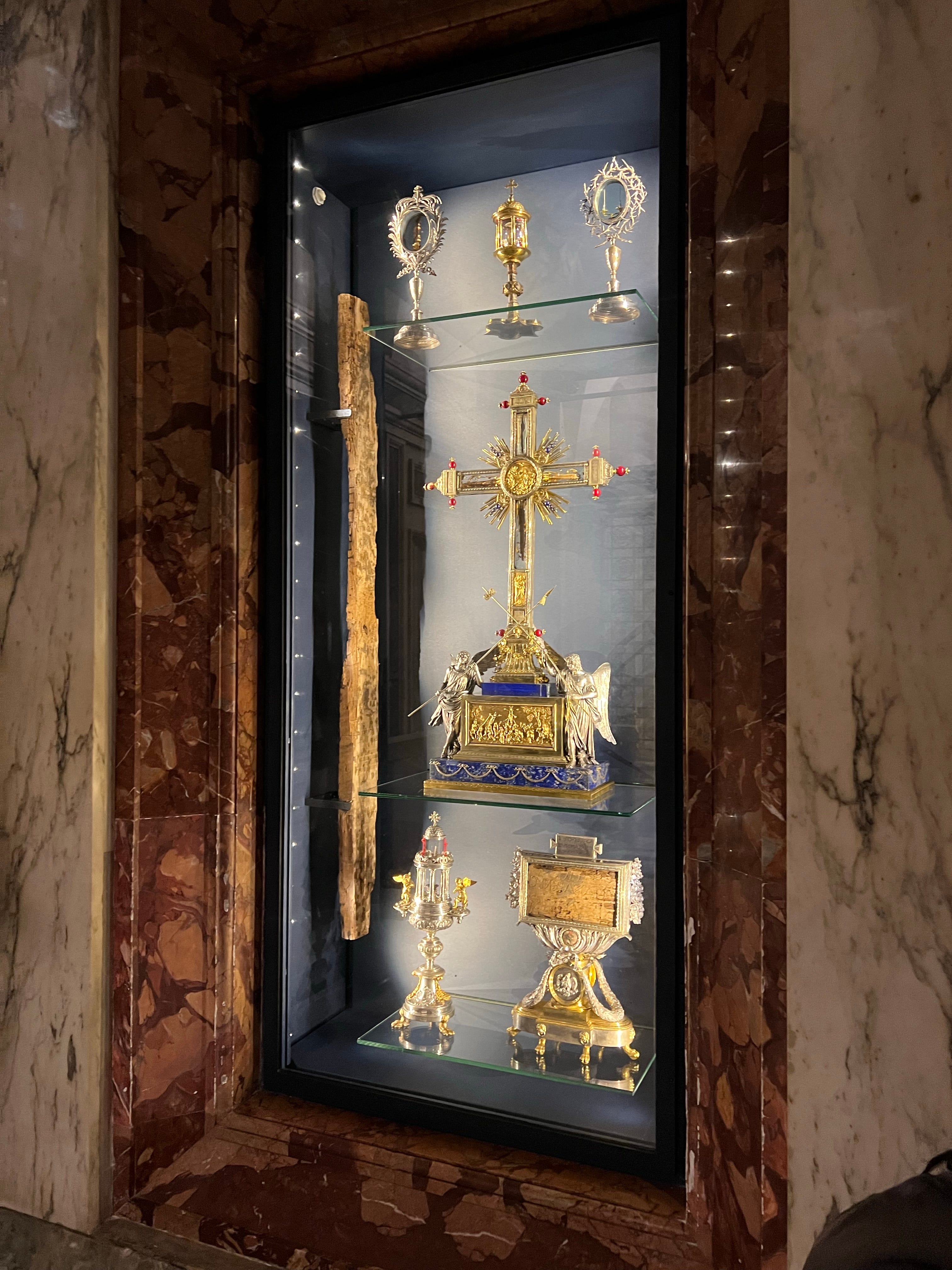
There’s a chapel in Rome that I truly love, maybe more than any other, where I have knelt so many times and felt overwhelmed. I love this chapel so much, and yet I find it almost impossible to pray there because my mind never lets me move on from the sheer amazement of where I am and what I’m doing. To me, it’s a scandal that this isn’t among the most popular spots in Rome, and even more unsettling is that so few people seem to mention this place or even know it’s there.
It’s a little-ish church by Rome’s standards, sandwiched off a quiet park between the Lateran and the Porta Maggiore on the Esquiline Hill. It’s the Church of Santa Croce in Gerusalemme, and the chapel behind it contains the relics of Christ’s passion brought back from Jerusalem by St. Helen, the mother of Constantine, in the fourth century. The church is called “Holy Cross in Jerusalem” and not “of Jerusalem” because Helen even brought several tons of dirt from Jerusalem, which was spread as part of the church’s foundations.
I’ve long been fascinated by this chapel: is it possible that I’m really kneeling in front of a beam of the good thief’s cross, the finger of St. Thomas, a nail that had pierced the hand or foot of Christ, and even the titulus, with the handwriting of Pilate still visible, that had declared this man to be IESVS NAZARENVS REX IVDEORVM, Jesus of Nazareth, King of the Jews?
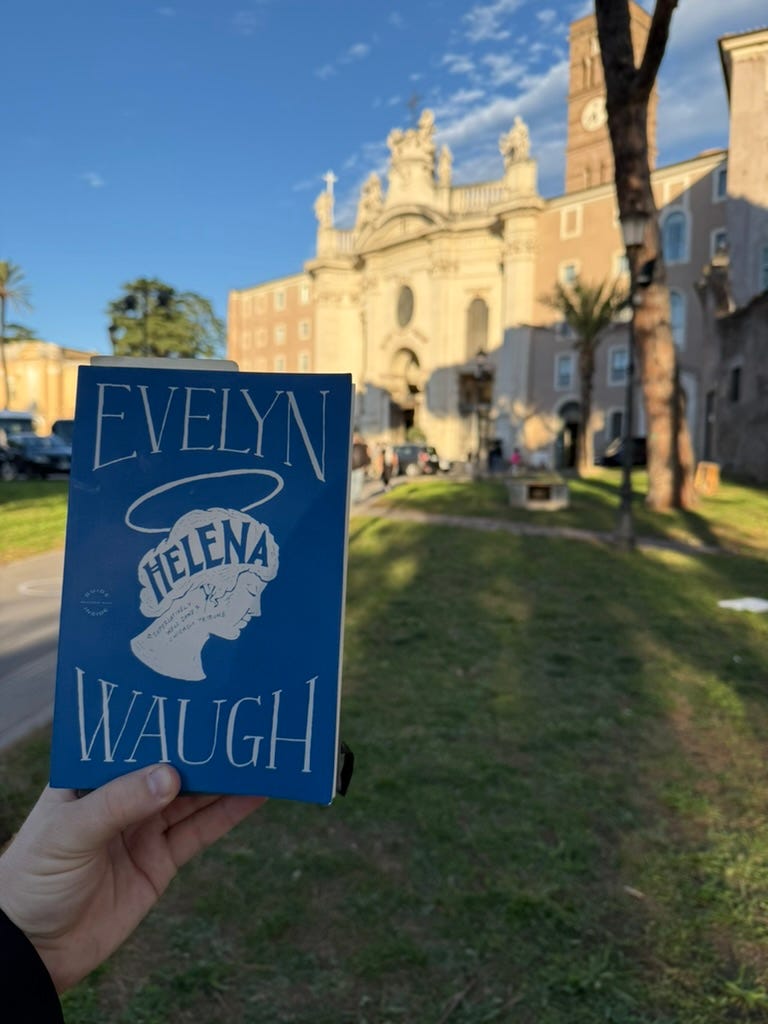
As fascinated as I am by this chapel and the legends surrounding it, the British author Evelyn Waugh has given me another reason to stop and marvel, and that is the story he presents of the Empress Helen, her conversion, and her pilgrimage in his 1950 novel, Helena.
This is Waugh’s most uncharacteristic book and, according to him, his favorite, which I think tells you something about Waugh, since it is neither his funniest book nor his most technically accomplished. It is a short piece of historical fiction about Constantine's mother, written just a decade after he’d skewered the English upper classes in Handful of Dust and five years after reawakening the imagination of Britain’s Catholics with Brideshead Revisited. Waugh made a name for himself by fusing wit and the little things of life to bring readers to themes of ultimate importance, but in Helena he quite soberly shows us something else: the human desire to be seen and known, and the fulfillment of the innate human longing for life everlasting.
Waugh’s Helen has almost no interior mystical life to speak of. She does not levitate, she does not receive locutions, and in fact we rarely see her pray. Medieval legends tell us that she is the horse-mad daughter of “Old King Cole” from the British Isles who grows up to marry an ambitious Roman soldier who tosses her aside when he becomes politically useful enough to need a better marriage. From the sidelines, she watches her son become the most powerful man in the world, and spends her old age troubled by the increasingly strong stirrings within her spiritual self.
Waugh surrounds her with every fashionable heresy of the age: Gnostics who think matter is beneath God’s notice, philosophers who prefer their truths abstract and unencumbered by anything so vulgar as a date or a place, courtiers drifting toward Arianism because it’s intellectually (and politically) easier. Helen views these as intellectually and spiritually lazy. She wants to know where. She wants a when. Her recurring question, needling every theologian who tries to spiritualize the Incarnation into a nice idea, is essentially: yes, but what did He actually touch, and can I go stand there? Tired of the monotony of her life at the Sessorian palace in Rome (now the site of Santa Croce in Gerusalemme), she does something that appears to the civilized world as either overdone devotion or the fruit of mental illness: she goes to Jerusalem and starts digging, motivated by one thought alone: if Jesus really died on a cross and rose from the dead, then there must be something concrete there to tell me it’s true.
In place of the usual sanctimonious hagiography so common in lives of the saints, Waugh gives Helen a tenacious, real, and relatable substance. By the time she gets to Jerusalem, she is well over seventy, Hadrian had built a temple over the supposed site, and nobody who might remember anything useful is still alive. The empire’s finest theologians have moved on to arguing about the nature of the Trinity and have no patience for an old woman’s insistence. She digs anyway. Waugh’s Helen is not content with faith that remains a hopeful feeling; faith, for her, moves the heart out of itself and toward real action. If faith is based on facts, she seems to say, and if those facts are buried somewhere out there, then sometimes a living faith means doing the work to unearth them so that countless more may come to believe.
When they ask him where he is staying, Jesus invites his disciples to “come and see.” (Jn. 1:39) Helen’s motto is similar: quaesivi et inveni - I sought and I found. In his 2008 address at the Collège des Bernardins in Paris, Pope Benedict XVI brought back into our conversation the marvelous phrase, so often used in ancient times to describe the essential posture of man’s soul, quaerere Deum - the search for God. Every person possess the imago Dei (image of God) and therefore also the capax Dei (capacity for God). I’m reminded of St. Augustine’s belief that “to search for God is the greatest human adventure…and to find God is the greatest human achievement.”
Helen’s tenacious seeking throughout this novel finds its completion in a completely anticlimactic way: they dig where the legend told them to dig, and they found what the legend told them they’d find. In some ways this is both the simplest and most profound truth the spiritual life can give us. We must learn to ignore or at least mitigate the myriad distractions that call us away from the simplicity of this quest, and very often we will only learn how to do this through painful and difficult lessons.
If you know about St. Helen, it’s probably because you know she’s the one who rediscovered the True Cross and brought it to Rome. If that’s what you know about St. Helen, then it’s only natural to assume that a book about her would really be a book about that. From this perspective, Waugh’s account of the discovery of the True Cross is somewhat unsatisfying; but this is exactly why it works. There is no choir of angels, no heavens opening, no Star of Bethlehem, no voice of the Father. There, in a muddy pit, is an old woman, three crosses pulled from an ancient cistern, with no way of knowing which one is the one. The wonder is in the fact that the thing was there at all, waiting under Hadrian’s rubble, exactly where the story said it would be, for anyone patient enough and humble enough to look beyond the theory and actually pick up a shovel.
That is Helen’s gift to the Church, and I think it is the gift Waugh most wanted to give his readers: the reminder that Christianity is not merely a philosophy that happens to have some historical trappings. It is a series of claims about actual places and actual objects and actual dates and actual people. To the many Christians who are tempted to let their faith drift upward into abstract oblivion, and likewise to the many who sometimes forget to let wonder and awe pierce them deeply, St. Helen will be interceding for you with dirt under her fingernails, inviting you to help her dig.
St. Helen’s feast was earlier this week, and it has always struck me as fitting that the Church gives her a summer feast day, unhurried and a little overlooked, for a saint whose entire holiness consisted of refusing to hurry off in search of something easier to find. If you are looking for a patron for the parts of faith that are less about consolation than about persistence, for when faith feels like digging for a long and fruitless time, may I suggest the elderly mother of Constantine, an old woman with a shovel who believed what only Christian hope can teach us: the wondering isn’t for nothing, the searching isn’t in vain, and the digging deep is only the beginning of true wonder and abundant life.
Quaesivi et inveni. Keep digging. What you’re looking for is usually right where they told you it would be.
Here’s an excerpt from a Helen’s monologue before an image of the Three Wisemen in Bethlehem (pp.199-201)
“This is my day,” she thought, “and these are my kind.”
“Like me,” she said to them, “you were late in coming. The shepherds were here long before; even the cattle. They had joined the chorus of angels before you were on your way…How laboriously you came, taking sights and calculating, where the shepherds had run barefoot. How odd you looked on the road, attended by what outlandish liveries, laden with such preposterous gifts!
”Yet you came, and were not turned away. You too found room before the manger. Your gifts were not needed, but they were accepted and put carefully by, for they were brought with love. In that new order of charity that had just come to life, there was room for you, too.“You are my especial patrons, and patrons of all late-comers, of all who have a tedious journey to make to the truth, of all who are confused with knowledge and speculation.
“Dear cousins, pray for me….For His sake who did not reject your curious gifts, pray always for all the learned, the oblique, the delicate. Let them not be quite forgotten at the Throne of God when the simple come into their kingdom.”