


Man’s Search For Meaning
Victor E. Frankl
First published 1956, current printing by Beacon Press. 165 pages.
—
Victor Frankl’s book, Man’s Search for Meaning, does what many great books wold like to do but have trouble doing, and that is: speaking to the lived or perceived experience of as wide a gathering of people as possible. Having sold over 18 million copies since its first printing in 1956, this book finds itself in the center of a very interesting Venn diagram: the current publisher, Beacon Press, publishes under the auspices of the Unitarian Universalist Association of Congregations1, and yet this is a text used in undergraduate psychology classes, sociology dissertations, atheistic/humanist reflections, Catholic Great Books programs, and this priest’s nighttime reading.
The reason for this is not hard to pinpoint: the search for meaning unites every person, everywhere. This books touches the basic, nagging question that wells up in the heart and mind of anyone who is awake enough to notice the weirdness of their life: “there’s surely more to life than…this, right?” This question, Frankl suggests, is heavy and unshakeable whether it’s born from dissatisfaction with the circumstances, distress about the conditions, or boredom from the vacuum of life.
The search for meaning is pitted against Marx and Nietzsche’s search for power and with Freud’s search for pleasure. All of life, according to these thinkers, is summarized in either the search for domination and control or the selfishness of endless pleasure.
The ability to ask this question and take seriously the various answers one comes up with are crucial parts of being alive, and the ability to face one’s circumstances with an openness to a deeper meaning2 is what saves a person from the monotony of trough-to-trough hedonism, and from the temptation to think she has become the ruler of her own world; both of these end up in the same place: living in such a way so as to ensure that everyone else is as miserable as you.
For more than half the book, Frankl applies the lens of meaning to his time spent as a prisoner at Auschwitz and Dachau, what he admits must seem to most readers as the most meaningless place in all the world. He writes that many of those who survived the initial sorting but later died did so because they had simply given up; their circumstances had become too much…a completely understandable reaction to the depravity and horror in which they were living.
But those who survived these unimaginable conditions did so because they were able to find freedom and meaning within themselves, freedom and meaning that no exterior circumstance could take away from them.
Near the end of his reflections on the concentration camps, and by way of a parentheses, Frankl summarizes the heart of his claim:
The consciousness of one’s inner value is anchored in higher, more spiritual things, and cannot be shaken by camp life. But how many free men, let alone prisoners, possess it? (63)
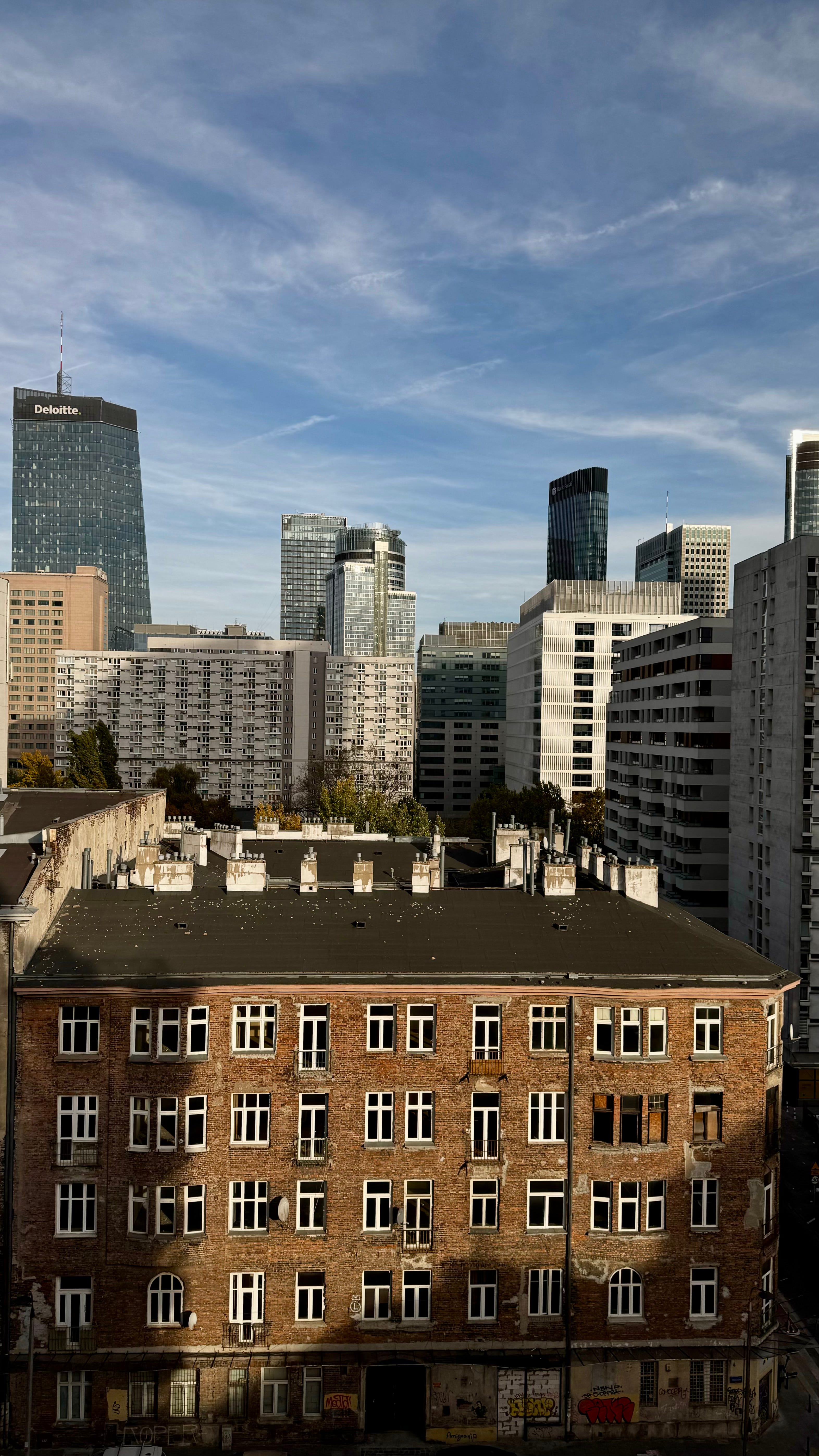
My brother’s apartment in Warsaw is situated in the heart of what was once the Jewish Ghetto. Today, there are plaques and historical markers spread throughout modern apartment buildings and shops; how interesting it is to see these buildings, which were 80 years ago the scene of unimaginable horror and difficulty, now standing in the shadow of modern skyscrapers the hustle of what is, by all accounts, a normal rhythm of life. These Ghetto buildings sit dark and abandoned, like ghosts, stark reminders of the sheer evil of which humanity is capable.
I spent a lot of that trip Googling these buildings, and reading about life in the ghetto. Hidden within the tales of woe and depravity, a different story began to stand out: hope and life. Many of the residents of the Warsaw ghetto did what they could to continue life as normal; they formed relationships, created art, discussed books, cooked together, and even managed to organize a small symphony orchestra. There was a sense that although more and more external liberty was being taken away, there was something more fundamental and human that the Nazis couldn’t take: an interior freedom strengthened by the emergence of humanity and meaning. Not only could this freedom not be taken, it could not touched; on the contrary, it was somehow able to grow.
And here is the crux of Frankl’s proposal: human despair plummets a person downward into an abyss of darkness, but it is not infinite; eventually, once hope is exhausted and despair takes a strong enough hold, there becomes only one way out.
But human freedom is quite a different story. When the innate human desire for meaning is allowed to flourish, a person becomes limitlessly free. Freedom only grows, increasing exponentially, until the human sees even captivity, sickness, danger, and tribulations of every sort as (somehow!) a profound and limitless gift.
I want to finish this book report with quite a lengthy quote from Frankl himself, with my added emphases.
In attempting this psychological presentation…of the typical characteristics of a concentration camp inmate, I may give the impression that the human being is completely and unavoidably influenced by his surroundings. But what about human liberty? Is there no spiritual freedom in regard to behavior and reaction to any given surroundings?…
The experiences of camp life show that man does have a choice of action. There were enough examples, often of a heroic nature, which proved that apathy could be overcome, irritability suppressed. Man can preserve a vestige of spiritual freedom, of independence of mind, even in such terrible conditions…
We who lived in concentration camps can remember the men who walked through the huts comforting others, giving away their last piece of bread. They may have been few in number, but they offer sufficient proof that everything can be taken from a man but one thing: the last of the human freedoms - to choose one’s attitude in any given set of circumstances, to choose one’s own way…
Fundamentally, therefore, any man can, even under such circumstances, decide what shall become of him - mentally and spiritually. He may retain his human dignity even in a concentration camp. Dostoyevsky said once, “There is only one thing that I dread: not to be worthy of my sufferings.” These words frequently came to my mind after I became acquainted with those martyrs whose behavior in camp, whose suffering and death, bore witness to the fact that the last inner freedom cannot be lost.
It is this spiritual freedom - which cannot be taken away - that makes life meaningful and purposeful.
Victor Frankl, Man’s Search for Meaning, 65-67.
“We don’t know if there is a God, or if there is, which one it might be; but just in case, we worship.”
Which is not the same as “everything happens for a reason :) :) :)”