


It’s probably the most common question from people discerning a religious vocation.
“But, won’t I be, you know…lonely?”
“Well yeah, kid, you’ll be lonely. Sometimes, anyway.”
And then follows a very well meaning discussion about the nature of loneliness and the difference between loneliness and solitude. Solitude can be chosen, cultivated, even enjoyed. Solitude is modeled in the Gospels by the Lord himself.
But the loneliness people are afraid of is something else: the experience of being surrounded by people you can’t quite reach, in a life that fits you imperfectly, doing work that matters to you in ways you won’t be able to fully explain to anyone else in your life. It is the loneliness of the person who has found something real, like a vocation, a true love, or a sense of what their presence in the world is for, and is discovering that this finding does not automatically produce connection or understanding with others.
Ask anybody: this kind of loneliness does not discriminate. It’s not limited to those in religious vocations, but is felt at least somewhat, at some point, by everybody. Why? Dunno. \_=/_/
“More tortuous than else is the human heart, beyond remedy; who can understand it?”1 This feeling, and how to live with it, is what John Williams (no, the other one) has given us in his 1965 novel, Stoner.
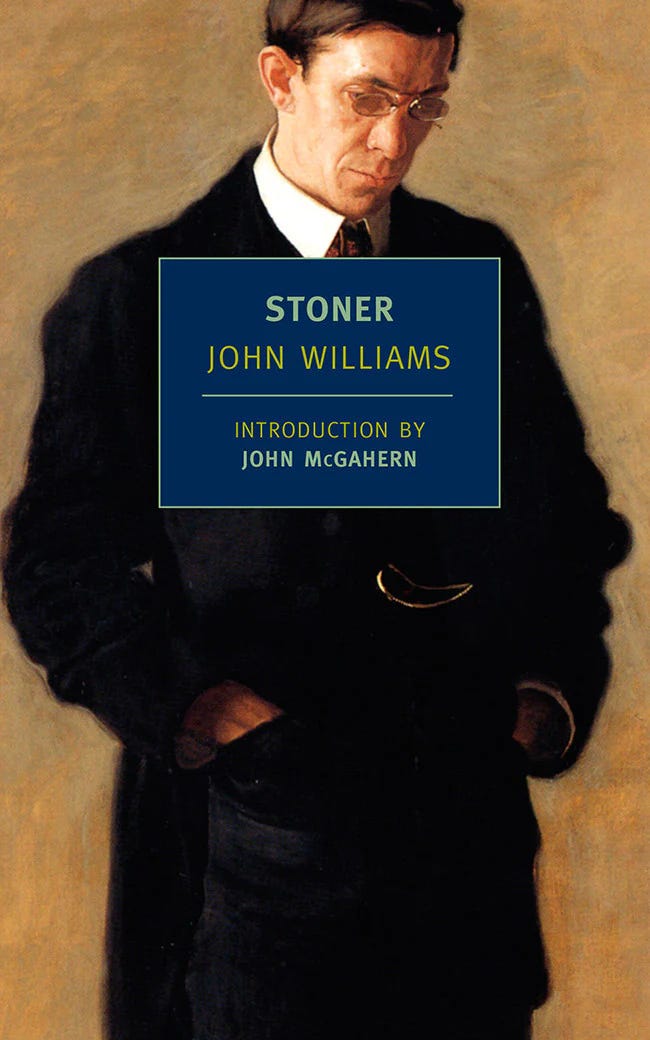
The novel’s premise is deceptively simple. William Stoner is born to Missouri farm parents, sent to the state university to study agriculture, and in the middle of a required survey course on English literature, he falls irreversibly in love with words. He turns down the farm, stays on campus, studies more, and becomes a professor. He marries a woman who doesn’t love him. He has a daughter he can’t protect. He is trapped in a decades-long departmental war which he all but loses. He experiences true love only once, an affair with a colleague which ends because the “man at the desk” needs it to. He publishes one modest, largely-unread scholarly book. He dies at home, alone, holding it.
That is the whole story.
John Williams presents the life of William Stoner with some of the most beautiful prose: it’s spare, precise, and merciless. But as he reads, the reader is given the sense that Stoner’s life, for all its apparent failure, is being told to you by someone who thinks it matters enormously. And somehow the fact that Williams thinks this life is worth reading, the reader reads on.
The novel’s central wound is what I want to call the problem of lonely togetherness. Stoner is almost never literally alone. He is surrounded, at every turn, by people who share his space and claim his attention: Edith, his wife, who manipulates even the layout of their home as a displacement activity for feelings she cannot name; a daughter he loves with an inarticulate fierceness that Edith dismantles; parents to whom he returns dutifully, speaking in sentences that say almost nothing, because “almost nothing” is all there is to say. Not only does Stoner stay, he never even entertains the idea of leaving. He endures! And Williams wants you to notice that endurance is not the same thing as resignation; endurance of trial gives life its own kind of dignity, even when everything else seems so undignified.
The “lonely togetherness” is most acute, most painful to witness within Stoner’s marriage. Edith is not a villain, exactly. She is a person shaped by damage from her own childhood in a moneyfull and loveless home; she holds grief over her father’s financial ruin and suicide that she has no tools to process; she marries Stoner out of an unspoken social imperative and then punishes him for the rest of their shared life. Her cruelty is not dramatic: it is domestic and granular, and she destroys his confidence and wonder through small decisions made over decades. Stoner absorbs it the way he absorbs most things: stubbornly, looking forward to returning each morning to the one place that still makes him feel something positive and real.
That place is his classroom. This is where Professor Bill Stoner earns the reader’s respect and pity. Stoner teaches because literature woke him up. It made him realize that the words of a sonnet written four hundred years before his birth could be addressed, specifically and personally, to him. When this happens to Stoner, it changes the direction of his life. And Stoner spends the rest of his career helping to make it happen for his students. He isn’t always successful, as no teacher ever is. Some students don’t care, and he knows it. But some of them really do, and in these he can see the same awakening, and to these students he devotes everything he has.
This is not nothing. Anyone in education will tell you that this, actually, everything. And so, as the novel moves toward a quick and quiet conclusion, something happens for which the reader ought to be very grateful: we are reminded that Stoner’s life looks like an apparent failure because we have brought to our reading the harsh and unrealistic judgement of an unfair and inhuman world. He did not win the departmental politics. He couldn’t save his daughter from the wreckage Edith made of her youth. He let Katherine, the woman he loved, leave. His marriage meant nothing to either party.
At the end of his life, a cancer-ridden Bill Stoner returns to the modest book he wrote on a topic he truly loved. Lying there, alone in his makeshift bedroom at the back of his house, the only room Edith allowed him to make his own, he feels something Williams describes with a phrase that has followed me since I first read it: a kind of joy, “as if borne in on a summer breeze.” Not triumph. Not vindication. The kind of joy that does not require the attention or approval of anyone else. And for Stoner, that kind joy is the greatest thing he could have found.
As I pack up parish ministry and head off to study canon law, I can’t stop thinking about this novel. Parish life is relentlessly relational. You are with people at their most unguarded: at bedsides, in confessionals, at gravesides, in the sacristy at seven in the morning when no one is performing anything for anyone. You share meals and seasons with people you didn’t (and maybe wouldn’t) choose but find yourself loving nonetheless with the tenderness of friendship and the fierceness of family. And you are still, in some fundamental way, alone. Not isolated, certainly, but lonely in the more precise sense I mentioned at the beginning. There are things a priest carries that he cannot put down on the table over dinner. There are joys he cannot adequately explain and griefs he can’t fully share. He lives, in some sense, in the same condition as Stoner: among people, for people, and in a type of solitude that those people cannot and, probably, should not be given access to.
What the priesthood offers — what any vocation offers, if it is real — is exactly what Williams gives Stoner in that final scene. What it offers is the possibility that the work itself was real, that the love it expressed was real, that the awakening those students experienced in his classroom was real. It gives the priesthood the sense that everything done in silent sincerity, known only to God and the priest, is real. Stoner dies holding the book he wrote and was proud of. He doesn’t die holding his marriage or his career or his daughter’s hand. He dies holding the one thing he made that was uniquely his: evidence that he paid attention, that he cared, that he showed up. For the reader who removes the inhuman and unfair criteria for judging a successful life, it’s clear that this moment is not just a consolation prize.
It is, in fact, the prize.
Like every good author, John Williams has written a book trying to express something about being a human. We are made for more than that which our circumstances open up for us right this second. We carry in us a capacity for love and understanding and communion that the daily lived experiences of our lives will rarely fully accommodate. Most of us will live, in some measure, lonely together. The question the novel poses in its final pages is whether the work we did in the meantime was real, and whether we, in the end, can be okay with being alone in recognizing that fact. Stoner came to be okay with it. Reading this novel, I find myself inclined to look less harshly at the past, more tenderly at the present, and more calmly toward a future full of hope.
Stoner was published in 1965 by Viking Press. It is available in a New York Review Books Classics edition, which is how most people discover it.
(Read it slowly. It rewards that.)
Jeremiah 17:9