


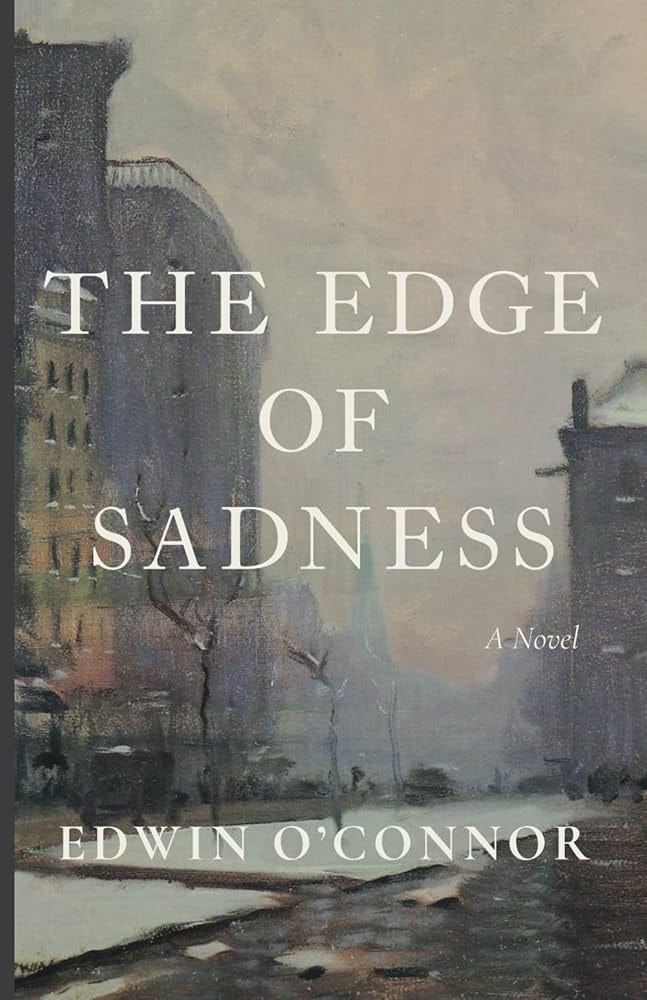
A priest’s life is first and foremost a life of repetition. Secondarily, but just as importantly, it is also a life of interruption. There’s a stretch of every priest’s life where the days begin to feel like they’re being lived by someone else. He says Mass, he visits the sick, he sits through meetings, he writes the homily, he eats dinner alone or with a brother priest, and somewhere in the middle of all of it he realizes that he’s gone a long time without being particularly present to any of it. Not necessarily unhappy. Not in crisis. Just a little to one side of his own life.
I don’t know of any novel that describes this condition with more honesty or tenderness than The Edge of Sadness by Edwin O’Connor.
O’Connor’s 1961 novel, which won the Pulitzer Prize for Fiction, went the way of many great Catholic novels and has essentially disappeared from the conversation. I hadn’t even heard of it until a friend recommended it last winter.
The story is narrated by Fr. Hugh Kennedy, a fifty-five-year-old priest in an unnamed New England city. (A priest named “Kennedy” in a book written by “O’Connor” in a major New England Archdiocese? It’s Boston, of course) Fr. Hugh is the pastor of Old St. Paul’s, a once-grand parish now reduced to a handful of old-timers and transients in a neighborhood the diocese has more or less forgotten. He has been sent there, the reader gradually understands, as a kind of soft landing after a long bout with alcoholism and an all-but-imposed period of treatment, a “rest cure” that has become permanent, and that suits him just fine. He is, by his own reckoning, neither happy nor unhappy. He and his newly ordained vicar are keeping the doors open. He is, as he puts it himself, living near the edge of sadness.
The novel begins when Fr. Hugh receives a phone call from Charlie Carmody, the cunning, gregarious, slightly insufferable patriarch of a family Fr. Hugh has known since boyhood. Charlie is turning eighty-two and, despite years of no contact, wants Fr. Hugh at his birthday party. From that small social hook the entire novel unfolds: an old friendship resumed, a family reentered, a past confronted, and a man slowly waking up to the life he hadn’t realized he’d half-abandoned.
In the early part of the book, Fr. Hugh describes a new nightly ritual he’s fallen into, one that’s new to him; a disconcerting ritual that was absent even in the lowest moments after the loss of his father or the rock bottom of alcoholism.
He comes into the rectory at night, slightly tired but slightly numb. He finds that he sits for an hour or more in his room before getting into bed, and finds that he is doing nothing at all: thinking of nothing in particular, waiting for nothing in particular. He’s quick to say these moments were not filled with unpleasant thoughts or feelings, because they seemed to lack any thoughts or feelings at all. This, he realizes, is precisely what’s wrong with these moments. A priest is not meant to feel nothing. A priest is meant to be, perhaps, a man more available to feeling than others, first to his own feelings so he can be open to the feelings of his people.
Fr. Hugh admits that without trying he’d been arranging his days, his relationships, so that very little could reach him. A lot of us do this: what can’t reach us, can’t hurt us. A major arch of this book is watching this priest, this person, realize the other side of that arrangement: what can’t reach us can’t help us, either.
That realization represents the entire novel in miniature. And it is the diagnosis of a particular kind of spiritual condition that I suspect a great many of us, no matter what calling or path, will recognize right away if we’re honest.
What O’Connor does so well, and what makes The Edge of Sadness so different from the more famous Catholic novels of its era, is that he refuses to subject the priesthood and the Christian life to the merely melodramatic. He humanizes the monotony that Bernanos makes so unbearable in Diary of a Country Priest, and he avoids altogether the scandal and shattering conversion in Graham Greene’s The Power and the Glory. Fr. Hugh’s alcoholism is in the past by the time the novel begins; he is not tempted to relapse, and O’Connor does not manufacture some new crisis for him. The drama is interior, gradual, and almost imperceptible: a man being drawn back slowly into the business of caring about other people, largely against his will, by the sheer accumulated weight of those people’s needs, affections, and aggravations.
Charlie Carmody is the great comic creation of the book, and I would say one of the great comic creations of mid-century American fiction. He is a self-made Irish immigrant turned slumlord. He’s vain, manipulative, miserly, hilariously self-pitying, and also, somehow, lovable. His grown children loathe him, yet they can’t stop orbiting him. His friendships are transactional and yet, in their way, sincere. He is, as the kids say, “performative.” He’s spent eighty-two years constructing an elaborate performance of himself, and O’Connor gives him to us as a meditation on what such a life costs and what might lie beneath it. Charlie is the dark mirror of Fr. Hugh: the man who feels everything too acutely and manages it by turning his whole life into a long, charming lie.
This book is filled with quiet scenes…scenes, I must admit, I was sometimes tempted to skip on account of their winding verbosity. What I eventually realized, though, is that the all-too-detailed accounts of the humdrum parts of priestly life in the book were shining a light of deeper meaning on the more humdrum parts of my own ministry. (If you saw the most recent “Knives Out” movie, the phone call scene that starts as professional and becomes “Father listening to a woman who just desperately needs to talk” is not exaggerated even one bit; it really happens, and it happens a lot. A blessing and sometimes a hardship.)
Fr. Hugh hearing the same handful of confessions from the same handful of regulars at Old St. Paul’s; Fr. Hugh’s long, rambling conversations with his old seminary classmate John Carmody, Charlie’s son, who became a priest in part to get away from his father and whose burnout/disenchantment has been slower but has become far more cynical and toxic than Hugh; Fr. Hugh totally disassociating at the rectory dinner table as his newly ordained vicar pontificates the promising future of this dying parish; Fr. Hugh remembering his own father as a sincere and practical man, and in every way the antithesis of Charlie Carmody.
What continues to strike me is how unsentimental O’Connor portrays the priesthood itself. He does not romanticize it as many writers do, or emphasize its heroic aspects as our vocation directors did. He does not exempt his priests from the ordinary human capacity for self-deception, exhaustion, or despair. But neither does he reduce the priesthood to these things. Fr. Hugh’s vocation is real. His ministry at Old St. Paul’s, threadbare as it is, is real. The Mass he says for six old women on a Tuesday morning is real. O’Connor trusts the reader to see that something is happening in those small, unobserved corners of Fr. Hugh’s life even while Fr. Hugh himself cannot see it, and that what is happening there is, in the end, what saves him.
A priest who cannot come to terms with the fact that the heroism of his life is found in a heroic imitation of the Lord’s virtue of endurance and in his tolerance of monotony is a priest headed for somewhere sad. But this isn’t a life sentence to dour gloom; the whole Christian “thing” comes to life when each of us realizes for ourselves that it’s in the monotonous, daily grind that real life is lived and abundant life is found.
I appreciate The Edge of Sadness as a priest because it has given me permission to settle in a bit more completely to the “long middle” of this vocation. The days of the seminarian poster are over, and here I’m in the years that wouldn’t make much of a highlight reel, the years in which the early enthusiasms have burned down and the late consolations have not yet arrived. It is a novel, in other words, for the great majority of my life. And it is, in the most unobtrusive way, a deeply hopeful book. I wouldn’t call it “optimistic”, but hopeful, in an older and harder sense: it teaches that grace can reach a man to his depths even when his life is arranged in such a way that very little else can.
For those with eyes to see, the edge of sadness in any vocation turns out not to be a scary cliff but a promising threshold.
—
The Edge of Sadness Edwin O’Connor. 1961. Loyola Classics edition, 2005, paperback. 640 pages. Loyola Press.