


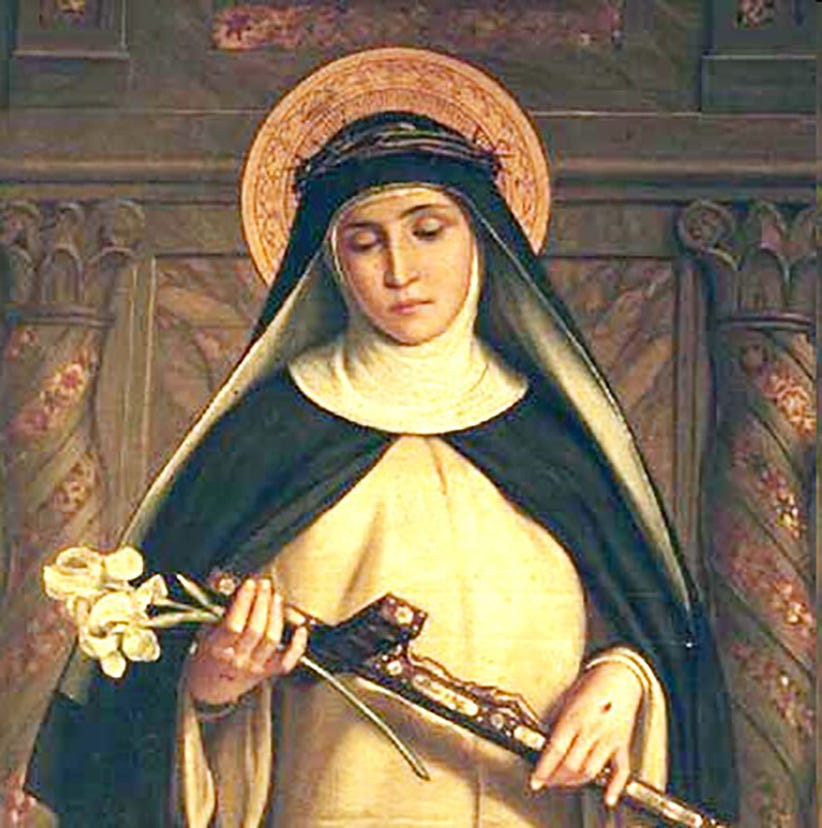
Sometimes we think that to be saints we have to find ways to be indifferent to all the complications of the world and society. Consider how Sigrid Undset describes the role of politics in the life and ministry of St. Catherine of Siena (1347-1380)
The artificial division of religion and politics did not exist for people of the Middle Ages. If they thought over the matter at all, they were completely aware that all the problems concerning the community - good or bad government, the welfare or misery of the people - are in the final instance religious problems. The fundamental question is, What do we believe a man to be? What is it he needs, first and foremost, so that he may be in a position to attain all his secondary needs - peace, justice, security, satisfactory relationships with fellow men?
Catherine never had any doubts about the answer. A man is nothing by himself, has nothing from himself. His existence is in his Creator, everything he is and owns is from his Creator. United with his Creator, who is boundless Love, eternal Truth, Wisdom personified, man receives his share of the qualities of the Divine - within the limits of humanity. If a man loves God, he will be able to love his neighbor, to attain wisdom, and to be just and truthful.
Because God is our eternal blessedness, a child of God becomes a blessing for his fellows. Love for one’s own ego, for something which is in reality nothing, leads to an abyss of nothingness. The love of a selfish man is nothing, truth escapes between hands, his wisdom will show itself to be foolishness, his justice injustice, and in the end a series of disappointments and mistakes will lead him to hell - to the devil who is the spirit of disappointment and barrenness. “Unless the Lord build the house, they labor in vain that build it.” Catherine knew the truth of these words.
(Sigrid Undset, Catherine of Siena, (New York: Sheed & Ward, 1954), 127-128.)