


Merry Christmas, everyone! Let’s talk about Virgil.
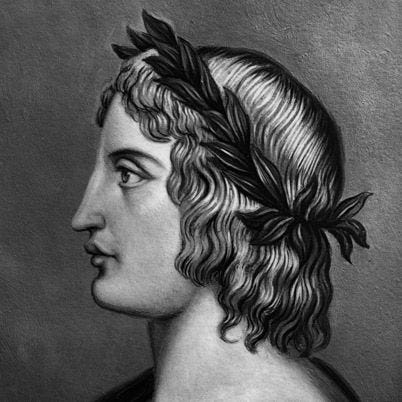
Who is Virgil?
Publius Vergilius Maro, whom we know today as the poet Roman poet Virgil, was born in or around 70BC, in the northern Italian city of Mantua. He was born a peasant, and came of age in the idyllic Italian countryside; this pastoral way of life came to provide a near endless wealth of imagery and inspiration for his writing.
Virgil lived and wrote in the politically tumultuous first century BC, when the Roman Republic was nearing its collapse. The civil war between Marius and Sulla had largely ended by 82BC, but the forces of Marius in Spain were not defeated for ten more years. This war was followed only twenty years later by the conflict between Julius Caesar - then a Roman general and the governor of Gaul - and the Roman senator Pompey. Caesar had crossed the Rubicon (the border between Rome and its provinces) with an army, which was against Roman law, and began an age of civil war and political strife that would only abate with the victory of Caesar Augustus over Mark Antony at Actium in 31BC.
Virgil’s youth and formative years were dominated by this political and social landscape, and his writing is marked by a knowledge of the horror of war but also by a unique understanding of the glories of post-war peace.
Virgil is regarded as the greatest poet of Rome. He is most famous for the Aeneid, his epic poem which tells of the founding of Latium in Italy and eventually the foundation of Rome. The Aeneid is the Latin addition to Homer’s Greek epics, The Odyssey and The Iliad. (BTW - Norton just published a pretty great new translation of The Iliad which those fellow nerds among us might want to check out.)
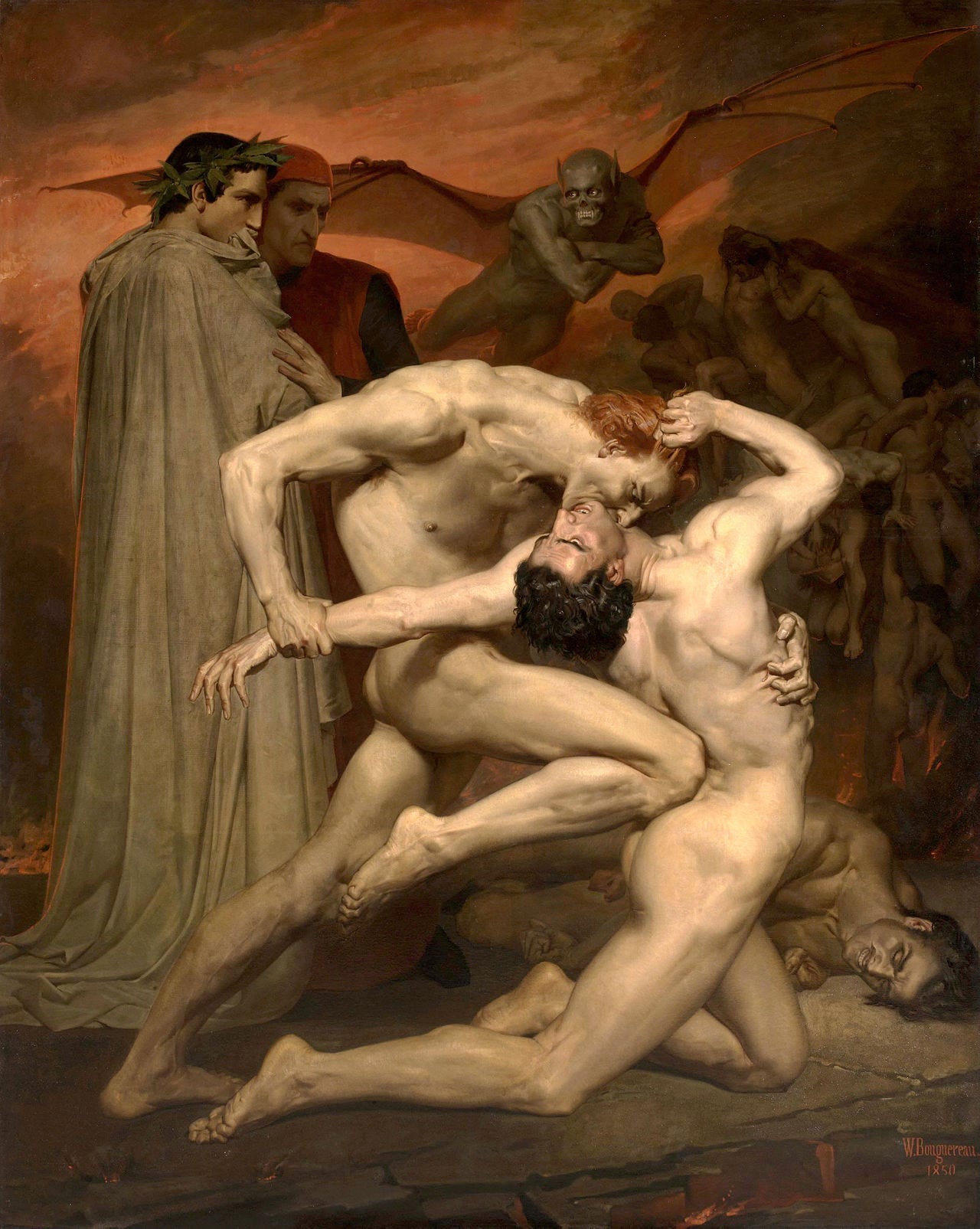
Virgil also takes pride of place in the Inferno and Purgatorio in Dante’s Divine Comedy. Dante’s great love Beatrice chooses Virgil to guide him to the doorstep of Paradiso, and calls him “the Mantuan”, “whose melodies / life in earth’s memory and shall live on / till the last motion ceases in the skies.” (Inferno 2.58-60). In the second canto, when Dante and Virgil enter Limbo, Virgil is greeted as the “Prince of Poets.” (Inf. 2.80).
The Eclogues
But before The Aeneid and long before Dante’s man-crush developed, Virgil composed The Eclogues, ten hexameter poems reflecting on the pastoral world in which Virgil was raised and which he revered. The Eclogues were composed between 42 and 37BC, and it’s toward Eclogue IV that I want to direct our attention. This Eclogue in particular has consumed so much attention in both ancient and contemporary writing and thought, as scholars and casual readers alike try to answer a very simple question: “Who’s the baby?”
If you’ve never read Eclogue IV, I suggest you do so. This is a good translation. You’ll have to scroll down to IV.
Virgil’s fourth eclogue tells about a wonderful birth set to happen any moment now, a birth following which a “glorious age” will begin. Throughout the centuries, there has been an incredible volume of discussion about the identity of this mysterious child. Ella Bourne notes that even during Virgil’s lifetime there was confusion as to the identity of the child1…some thought he was referring to the child to be born of the emperor Augustus and the more Greek-minded believed Virgil meant the birth of the god Mithras; some, like Asinius Gallus (the son of Pollio, whom Virgil mentions in l. 11 of the Eclogue) claimed that he himself was the one whose birth Virgil foretold.
Not surprisingly - but, in my view, really interestingly - there has “long been a persistent belief” that the child to be born is Jesus, “and that Virgil in this little poem was prophesying something greater than the birth of a son to his friend Pollio, or to the imperial house of Rome, something greater than the coming of the oriental god Mithras.”2
Bourne notes that even the Emperor Constantine believed this to be true, and dedicated large parts of his famous address to the “Assembly of the Saints”, which can be found on New Advent here. The writer Lactantius, a contemporary of Constantine, and even St. Augustine are on record suggesting that the child in the prophecy is Jesus. When you read the Eclogue, it’s easy to see why; if you put the Eclogue next to certain passages of Isaiah, it might be difficult for some to tell the difference.
Consider these lines from the middle of the Eclogue, that sound strangely like Isaiah 11:
He shall have the gift of divine life, shall see heroes mingled with gods, and shall himself be seen by them, and shall rule the world to which his father’s prowess brought peace.
[18] But for you, child, the earth untilled will pour forth its first pretty gifts, gadding ivy with foxglove everywhere, and the Egyptian bean blended with the laughing briar; unbidden it will pour forth for you a cradle of smiling flowers. Unbidden, the goats will bring home their udders swollen with milk, and the cattle will not fear huge lions. The serpent, too, will perish, and perish will the plant that hides its poison; Assyrian spice will spring up on every soil.
Not everyone in the ancient believed that Virgil was referring to Christ. Notably, St. Jerome dismisses this view as “puerilia” - childish.3 But Bourne notes that the very fact that someone of the caliber of Jerome felt compelled to weigh in speaks to the prevalence of the belief.
So, Prophet or Not?
If you’re looking for a fuller explication of Virgil’s Eclogues, you can find a lot of writing on Google or through JSTOR, if you have access to that. What I’m interested in here is the fact that this conversation has lasted for so long, through so many centuries. The answer, from a Biblical perspective, is “no”, Virgil wasn’t prophesying Christ. But is it really that easy? After all, depending on which sense of Scripture a person is employing while looking at, say, Isaiah 9, they’d be moved to conclude that Isaiah wasn’t prophesying Christ, either, but rather the birth and reign of his great hero (and a rumored messiah), King Hezekiah. But pretty much everyone would also say that Isaiah was prophesying Jesus Christ, he just didn’t know it. BUT…if Isaiah can prophesy Christ and not know it, then why can’t Virgil?
The Catechism teaches that the through the prophets’ words, “God forms his people in the hope of salvation, in the expectation of a new and everlasting Covenant for all, to be written on their hearts.” These prophets “proclaim a radical redemption of the People of God, purification from all their infidelities, a salvation which will include all the nations.” (CCC 64) The prophets’ warnings and teachings not only reveal the plan of salvation, albeit in parts, but likewise prepares Israel to “accept the salvation destined for all humanity.” (CCC 72)
One thing I love about the Fathers of the Church is that they are actually a lot more open minded than we are about things like this. They’re willing to pull together ideas and images from so many sources without being worried about watering down or disintegrating the central message of the Gospel.
Bourne notes,
That Vergil should have been held in high esteem by Christians is not surprising, if we consider that he was the pre-eminent classical poet in the minds of all during the early centuries after Christ, and that there was a tendency to see in him a close approach to Christian ideals. This was but a part of a more general tendency…among early church Fathers to find in pagan writers a certain spirit and a certain tendency toward Christianity, which was the more pronounced the greater the writer was.4
So, if we were having this conversation in my class and the bell was about to ring (which it always seems to be right when things are getting interesting), I would probably conclude with something like this:
Strictly speaking, I wouldn’t call Virgil a PROPHET in the same way I would use that word for Isaiah or Jeremiah; for one thing, the biblical prophets were speaking to Israel from within the people of Israel. See Abraham Heschel on that point.
However, God can inspire whomever he pleases. Further, the Church has always taught that the message of salvation is for all people of every tribe and tongue, and indeed every heart desires what Jesus will bring to it. Every culture and civilization has had religious practices, because (Giussani alert) each person possesses the religious sense.
So the fact that Virgil and his contemporaries were excited about the possibilities latent in the birth of some child, that they desired a golden age where the harvest would be abundant and the world might know peace is perhaps not so surprising. Insofar as they recognized those desires and somewhere deep down believed in hope that maybe, someday, those dreams would be fulfilled seems at least somewhat prophetic to me.
Ella Bourne, “The Messianic Prophecy in Vergil’s Fourth Eclogue,” (The Classic Journal, April 1916). 390.
Ibid.
Ibid., 393.
Ibid., 400.