


Veritatis Splendor #5 (#’s 28-41)
Freedom and the Fence
We often hear it: “It’s my life. I’m free to do whatever I want.” Freedom, in our world, is often defined as the ability to choose anything—with no interference, no restrictions, no rules. But is that real freedom? Or is it just the illusion of freedom?
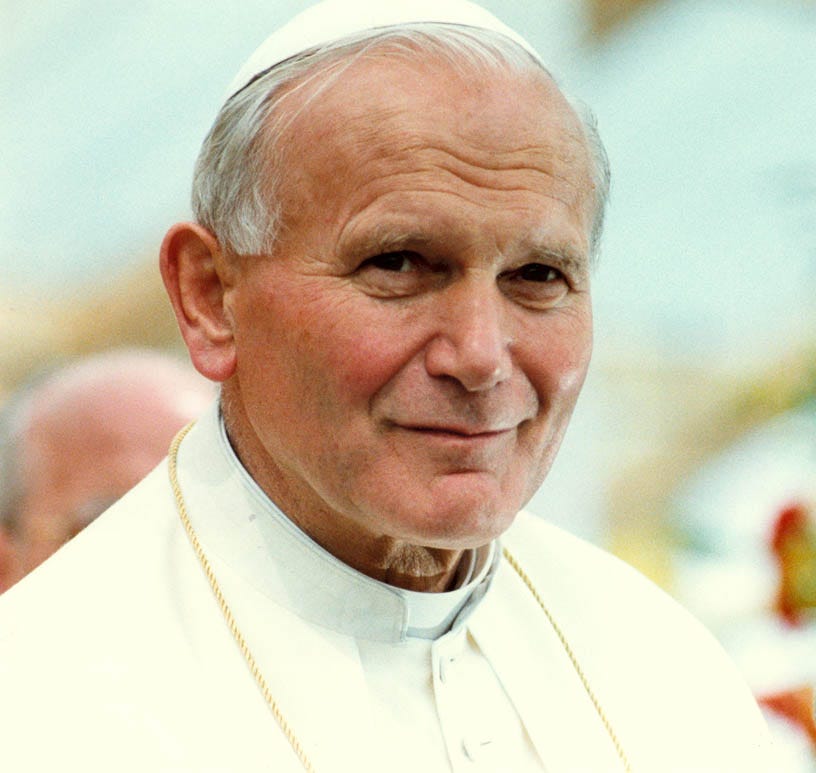
Pope St. John Paul II, in the opening section of Chapter 2 of Veritatis Splendor, offers a deeper vision—one shaped not by impulse or license, but by truth.
He begins with St. Paul’s striking words: “Do not be conformed to this world, but be transformed by the renewal of your mind.” (Rom 12:2) In other words, don’t let the world’s confusion shape you. Be renewed. Think differently. Let your life be conformed to Christ.
At the center of that renewal is a new understanding of freedom. Not freedom from truth, but freedom for the good.
In essence, freedom is not the ability to do whatever we want with no restrictions. Rather, it is the ability to live within the truth so as to know the good, to love the good, and to choose the good. This is a liberating message.
So many people carry a quiet anxiety: if I follow God’s law, will I lose myself? Will I be less free, less fulfilled, less happy? There is a popular Spanish social media influencer who is leaving it all to become a priest, and in watching interviews with him, that is the most common question: Why are you leaving all of this behind?
God’s law isn’t a fence to keep us in—it’s a railing to keep us from falling off the edge. It doesn’t restrict our freedom; it makes freedom possible. Without truth, freedom collapses into chaos, or worse, into slavery to sin and fear.
This section of Veritatis Splendor also addresses a crucial concern: can human beings really know the truth about right and wrong? The Church has always insisted that truth exists and that we can know it. Through reason, the human person can recognize certain universal moral norms. These are not “Catholic rules” imposed from outside—they are truths written into human nature itself.
This is called the natural moral law, and it applies to all people, everywhere—not as a limit on their autonomy, but as a gift to their dignity.
That’s a powerful thing to remember today. We live in a time in which so much is considered relative and changeable. But if truth shifts with the winds, then we are all adrift. The Church offers something much sturdier: a moral foundation built on rock and not the sands of cultural trends.