


Is there life after death? If so, what will it look like? If not, what are we Christians really doing?
Whether or not a person is “religious”, these are questions that every person will face; whether in a formal setting or simply while we’re alone in the car and wondering about life, there is an inherent curiosity about life, death, and what comes afterward that has the power to captivate each of us. This is just part of being human. Every culture throughout history has had beliefs and rituals covering life’s meaning, death, and the afterlife.
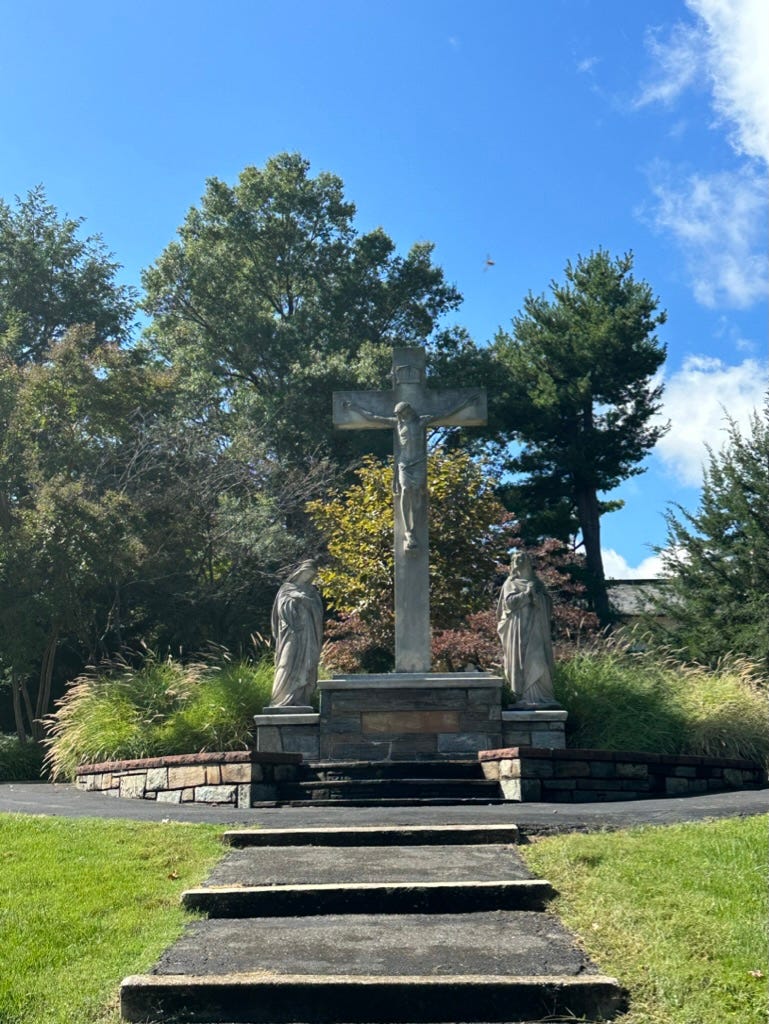
There were some who wondered about this even in the earliest days of Christianity. Paul’s first letter to the Corinthians calls out those who profess Christ but deny the resurrection of the dead: “But if Christ is preached as raised from the dead, how can some among you say there is no resurrection of the dead? If there is no resurrection of the dead, then neither has Christ been raised. And if Christ has not been raised, then empty is our preaching and empty, too, is your faith.” (1 Cor 15:12-14)
Belief in the resurrection can be hard. We’ve all been to funerals; as a priest, I’ve seen people die. There is a convincing and undeniable finality to seeing death, and at the same time there is something about it that seems so horrible, unjust, and wrong.
I believe very deeply that the reason we dress up our loved ones and prepare them for burial in such a way that they look merely asleep has less to do with the fact that we can’t face the grotesqueness of death and decay (although that is often very hard to witness) and more to do with the fact that if my loved one looks the way I remember them looking and they seem to be merely asleep, then this is a somber moment but not a final moment. In my experience of funerals, the rawest emotion is often shown at the graveside and not in the funeral home or even at the moment of someone’s death. Seeing the “final resting place” leaves us with no other mental place to go: “In the eyes of the world, N. is now dead.”
So what comes next, and how do we reach it?
St. Ambrose of Milan asked this question standing beside the body of his dead brother. Satyrus had died young, and Ambrose, the revered bishop who’d excommunicated the emperor and baptized Augustine, couldn't hold back his tears. He’s a beacon of orthodox faith and doctrine, and his brother's death has left him totally undone. In his funeral homily, Ambrose mourns his brother and asks a very honest question: why did my brother die? If we believe in the resurrection from the dead, then why must we endure the pain of death?
We die with confidence because the Lord died, and by dying he destroyed our death; we believe in the resurrection because the Lord was raised, and by rising he restored our life. In death, what is corruptible in us is sown like a grain of wheat; what goes to the realm of the dead as corruptible is raised as a harvest, full of life.
Ambrose gives a great and very human insight: if there is no God, if there is no grace, if there is no life after death, then we are right to avoid and fear it. If there is no grace, no life hereafter, then, as Paul told the Corinthians, “Let us eat and drink for tomorrow we die.” (1 Cor. 15:32) Ambrose writes, “Without the assistance of grace, immortality would be a burden.”
Here’s the trouble: even those who don’t know Christ yearn for immortality. Again, there is something primordial and deep, present in the documentary evidence of every human culture, that aims to resist death and crave immortal life.
The Greek heroes treated immortality as a prize, and Christianity treats it as a starting point for the fullness of life, but either way immortality is presented as the long-term goal of a human life lived well. Consider Tithonus, the mortal beloved of the goddess Dawn. She begged Zeus to make her lover immortal, and Zeus consented, but she forgot to ask for youth. Tithonus lived forever and withered forever, until his voice shrank to a whisper and his only wish was to die.
Oscar Wilde’s Picture of Dorian Gray is a similar example.
Here is the image at the heart of Ambrose’s insight: if you want to live, and I mean really live, then all the obstacles and corruptibility that prevent really living must die. If you want to really live, then you have to really die. If you just want to live forever without some kind of purification, then your life will become so monotonous that, like Tithonus, the greatest mercy you could wish for would be death.
This image of death and dying gives both import and urgency to our prayer on All Souls’ Day. Many who die in friendship with God are still imperfectly purified, marked by the attachments and the half-finished loves of a lifetime. The Church calls this state “purgatory”. It is neither a second chance nor a gentler hell. It is the assurance of salvation joined to the completion of holiness, grace finishing what grace began. St. Paul describes a man saved “as through fire,” and the Church has long understood that fire as the burning away of everything that cannot stand before perfect Love. If Tithonus withered in his immortality, the souls in purgatory are being cleansed and accompanied by grace so that immortality can be flourishing and abundant.
Long before Christ, Judas Maccabeus took up a collection and sent it to Jerusalem so that sacrifice might be offered for his fallen soldiers, an act Scripture calls “holy and wise.” (2 Maccabees 12:46) The earliest Christians carried this instinct into the catacombs, where inscriptions on the grave plead for grace and peace. Saint Monica, dying far from home, asked her son Augustine only that he remember her at the altar of the Lord.
The feast itself has humble roots. In 998, Saint Odilo, abbot of Cluny, ordered his monasteries to commemorate all the faithful departed the day after All Saints’ Day, and the custom spread across the Western Church. It is a Church-wide act of mercy, one of the oldest and most sincere forms of solidarity we have. The souls in purgatory cannot merit anything further for themselves; their time of earning has closed. We, the pilgrims, who would likewise love for our brothers and sisters to remember us when our time has ended, offer prayers, sacrifices, and Holy Mass on their behalf. The Church Suffering depends on the Church Militant, and the Church Militant, in turn, will one day depend on someone else.
St. Paul tells the Thessalonians that they should absolutely weep at the death of the ones they love, but that they should not grieve “as those who have no hope.” (1 Thess. 4:13). This kind of grief is exactly what Ambrose shows us. To pray for the dead is to insist that grace is still at work even in the realms we can no longer see, and that no soul has to carry the weight of eternity alone.
Five Ways to Pray for the Dead in November
Visit a cemetery between.
Pray there for the departed. With the usual conditions (sacramental confession, Holy Communion, and prayers for the Pope’s intentions), the Church grants a plenary indulgence applicable only to the souls in purgatory.
Have Masses offered. Ask your parish to offer a Mass for a particular soul, whether a relative, a friend, or a forgotten name from the parish rolls. Some families have Gregorian Masses (thirty consecutive days) offered for a loved one.
Keep a Book of the Dead. Write the names of your departed in a notebook or on a card, and place it by a candle or crucifix at home. Read the names aloud at family prayer each evening this month.
Pray the Eternal Rest. “Eternal rest grant unto them, O Lord, and let perpetual light shine upon them” takes ten seconds. Say it at mealtimes, after the Angelus, or at the end of each Rosary decade.
Practice mercy in their name. Give alms, fast on a Friday, or tend a neglected grave. Offer the small sufferings of the day for the souls who have no one to pray for them.
Fathers Ryan, this is the most memorizable, one may say, on the topic of end of life.
Most physicians are not taught this subject in medical school .
And yet it should be part of daily instructions for those who care for patients in nursing or hospice homes.
Thank you for your kindness yet meaningful contribution.