


Just before Christmas 2016, the rector, Fr. John Kartje, gave every seminarian at Mundelein a $25 Amazon gift card as a present. It was our yearly installment of the Kartje Kristmas Kash. I remember using mine that year to buy a new desk lamp for my room on campus; I still use it because I like that it has different settings, from warm to daylight, and can be either really dim or bright enough for open-heart surgery. We were on break, so I had it delivered to my house in Oswego where, being wingback-chair-less, I set up a Christmas break reading corner using a red lawn chair and my new lamp.
Finding a place to settle in and read was imperative that year because I was coming to the end of a new-to-me book by an author I was just encountering. The book is a novel about a small-town barber named Jayber Crow who, through his first-person narration of life, love, and work in Port William, was teaching me marvelous things about life, love, and work in my own world. I finished the book very late at night, in my lawn chair, in the darkness of my childhood bedroom, lit only by my little airport floodlight. I closed the book and set it down on my chest and just stared at the ceiling for a long time. New books are like new relationships: most are fine, and some are good, but now and then one comes along, and you just know you’re about to change for the better.
There are a lot of books that have moved me, changed me, and helped me live life better; this book, Jayber Crow by Wendell Berry, is a book that I have no problem saying literally changed my life. If I were forced to pick a single most impactful book on my understanding of myself, my life, society and societal change, modernity, falling in love, faith in God and in humanity, and death, it would be Jayber, without question.
If you had asked me, before that, what I thought a novel was for, I could have given you some perfectly serviceable answer about “character and plot.” Wendell Berry taught me that a novel has the power to be a confession, a pro-fession, offered on my behalf, so that through someone else’s life and voice I might more clearly hear and understand my own.
Wendell Berry died on August 31, 2026, at his home in Port Royal, Kentucky, at age ninety-two, on land his family had farmed for seven generations. In the month since his daughter, Mary, announced his death, the tributes have come from Kentucky governors and small farmers and monastic writers and from the full gamut of editors and literary quarterlies. That range of mourners is itself a kind of testimony. Few American writers managed to be beloved by agrarians, environmentalists, distributists, contemplatives, and plain readers all at once, and he did it without ever compromising the basic truths that moved him. We can hear Berry’s voice in that of Jayber Crow:
I am a man of losses, regrets, and griefs. I am an old man full of love. I am a man of faith.
Berry goes on to say, through Jayber, that “faith is not necessarily, or not soon, a resting place. Faith puts you out on a wide river in a little boat, in the fog, in the dark. Even a man of faith knows…we’ve all got to go through enough to kill us.” (356)
Wendell Berry was born in 1934 in Henry County, in north-central Kentucky, into a family of tobacco farmers. He studied at the University of Kentucky, then went for a Stegner Fellowship in creative writing at Stanford, and by twenty-eight had landed a position teaching English at NYU, exactly the kind of literary career an ambitious young writer was supposed to want (and one I’m jealous of!!) He stuck it out for two years and then came home, so he could farm and write from a place instead of just about one. Decades later, in his book, A Native Hill, he wrote that the land had once been his by accident, by happenstance, and now it was his by choice; the choosing of it makes all the difference. (Lovers of St John Henry Newman will recognize here Berry’s movement from notional to real assent, and likewise see here a real example of the difference that movement can make in our ability to love a place, a vocation, God, and ourselves)
Wendell Berry was part author and part activist. He will be remembered as one of the most serious and unglamorous defenders of small farms and local production of the last century, and his writing, both fiction and non-fiction, made the case with a patience that never gave way to nostalgia. In The Unsettling of America (1977) and The Gift of Good Land (1981), he argued that a nation which allows its farmland, its topsoil, and its rural communities to be treated as disposable inputs to an industrial system will eventually find that it has begun to make the same argument about people. Care for the land and care for one’s neighbor were, for Berry, the same thing, and he distrusted any economic vision that could not be answered for locally, in a particular place, to particular people. He wrote all of this by hand, in pencil, by daylight (and not by bright lamp), having farmed with horses rather than tractors for most of his life. He wasn’t LARPing for a different time, or living a merely performative existence. It was the argument, lived.
The fiction did the same work by other means. Port William, the invented Kentucky town where Jayber Crow, Hannah Coulter, and a dozen other novels and stories take place, is not an idealized rural past so much as a sustained study of what a place actually costs and gives, generation after generation, to the people who stay in it. Jayber himself, the town barber and unofficial keeper of its memory, spends the novel learning to love a woman and a community whose wholeness he can only ever glimpse in fragments, which is close to Berry’s whole vision of what fidelity to a place requires. He teaches his readers that anything real and good will require devotion that can’t be fully rewarded, at least not in this life, but is worth giving anyway.
I’ve read Jayber Crow alone or with groups at least four times; at 356 pages, it isn’t that long, but still it takes me two or three months to read. It’s a monumental project for my heart and mind, and (at the risk of sounding melodramatic) taking my time with this book is a matter of justice.
That said, Berry’s poetry offers similar depth on a varied scale, and serves as shot-sized portions of his writing and worldview. The Sabbath poems, written on Sundays over four decades, read like a farmer’s private prayers, unhurried and often unresolved. I loved reading them on the Taylor’s couch in Downers Grove.
My favorite of his poems, and probably his best-known, ”The Peace of Wild Things,” finds its way into the woods, where despair for the world gives way to the patience of a heron feeding and to the quiet of stars waiting overhead. When I moved to Washington last month, my friend Suzanne surprised me and sent me off with her beautiful painting based on this poem.
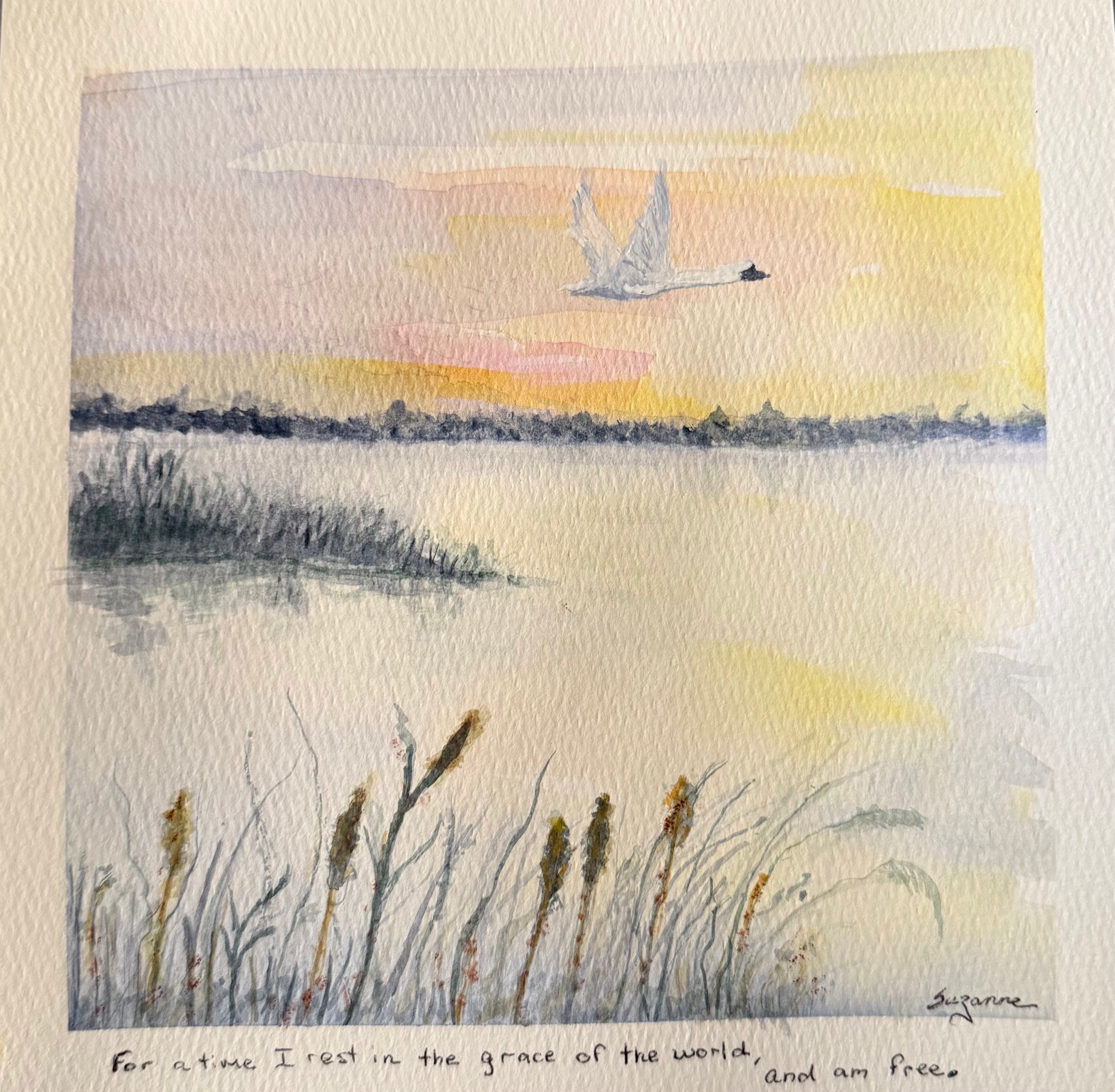
When I started Pilgrims’ Prologue, I chose for the tagline a line based on the writing of Wendell Berry: “Please tell me where the wildflowers are.” It was my spontaneous response to one of the Sabbath Poems:
“I dream of a quiet man who explains nothing and defends nothing, but only knows where the rarest wildflowers are blooming, and who goes, and finds that he is smiling by a will not his own.”
Wendell Berry did not set out to be a prophet, and would likely have spurned the title if someone ever offered it. He asked only that we pay more attention to the earth, to the sky, and the heart within ourselves and each person; the flourishing of one affects the flourishing of each. We must never forget each other, and must strive always to do right by the ground below us and the hearts around us.
The song he gave us in “The Peace of Wild Things” is his song now, and he rests and sings it now on, as Jayber calls it, “that beautiful shore.”
Read this poem with me slowly now, as a prayer for our brother and guide, Wendell Berry.
When despair for the world grows in me
and I wake in the night at the least sound
in fear of what my life and my children’s lives may be,
I go and lie down where the wood drake
rests in his beauty on the water, and the great heron feeds.
I come into the peace of wild things
who do not tax their lives with forethought
of grief. I come into the presence of still water.
And I feel above me the day-blind stars
waiting with their light. For a time
I rest in the grace of the world, and am free.