


I’ve had a blog since at least 2007…my first musings on MySpace, happily lost to the dark web, morphed into notes on Facebook, and then eventually found a home at CocaColaMan on Wordpress, and then was rebranded as the Little Shop of Words (read the first post ever here). Around 2017, the Little Shop of Words matured into fullness of age as ryanadorjan.com. Since then, with ordination and the insanity of life outside of the protective academic cocoon, that site has become a place mainly to share weekly homilies and to host my weekly podcast, Love Speaks. But the desire to start something more long form has always been with me, and I think the time is finally right.
At the moment, I’m on a sabbatical in Washington, DC. As far as sabbatical cities go, this is a pretty good gig. I’m a routine guy, so I decided that on Saturday mornings I’d take the Metro to DuPont Circle and grab coffee at un petit lieu s’appelle Un Je ne Sais Quoi and then walk down Connecticut Avenue, past the White House, and over to the National Mall and visit a different Smithsonian museum every week.
Well, to tell you the truth, I’ve actually only done that one out of the ~12 Saturdays I’ve been here…but it was a very worthwhile visit as far as this Substack is concerned.
I’d never seen the founding documents of the United States, which I was thinking put me on the list of bad Americans, so I decided to visit the National Archives. Being painfully oblivious sometimes, I walked right past the entrance while looking earnestly for the entrance, and fortuitously found myself at the back of the building, at the research entrance across Pennsylvania Avenue from the Navy Memorial, greeted by Robert Aiken’s two towering statues: Past and Future.
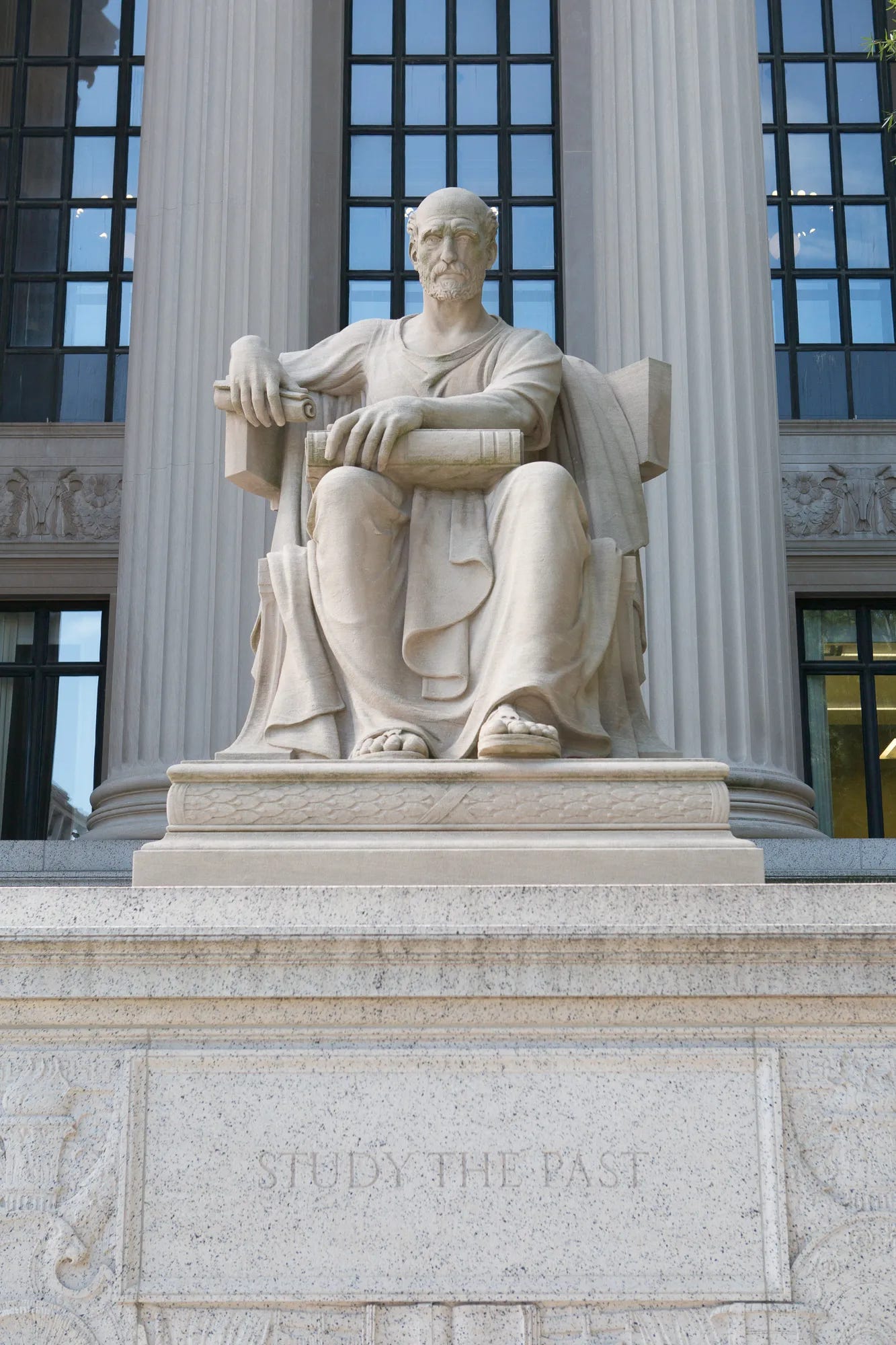
Okay, fine. It’s the Archives, and the research entrance to boot…”study the past” seems like a reasonable thing to put on the statue. It was the other one that really got me:
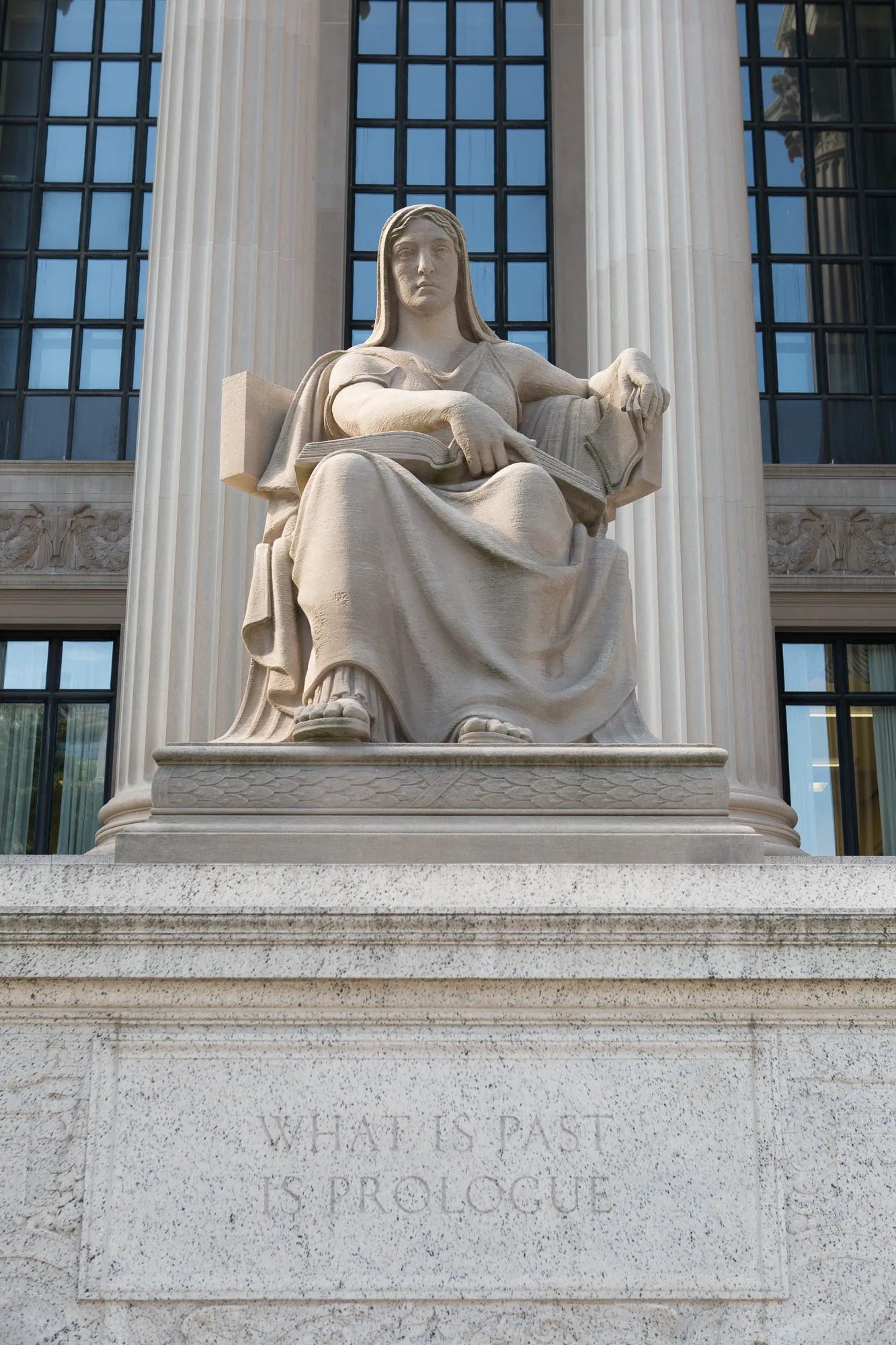
“What is past is prologue” comes from Act 2, scene 1 of Shakespeare’s The Tempest. Antonio uses this phrase as a means to convey the idea that everything he and Sebastian had experience until then had prepared them for the present moment. True enough.
The statue and the phrase shocked me, literally stopped me in my tracks; beauty does this as part of its quidity. Beauty, says Ratzinger, pierces us through like an arrow that comes out of nowhere, wounding us somehow both mortally and for the better. The inscription on that statue put into words what I had been trying to say, both to myself as I began a sabbatical after a really difficult period, and what I’d been trying to say in my “professional” life as a preacher and teacher, really looking at the health of the West and particularly of Christianity.
Outside the door of my room in the religious house where I’m living is a statue of the Little Flower, St. Thérèse of Lisieux. She’s got a lot of great sayings (she’s a Doctor of the Church, after all) but for me there’s one in particular that stands out:
“The world is thy ship and not thy home.”
We know that Thérèse struggled with something akin to our understanding of depression, and often wrote in Story of a Soul about intense bouts of loneliness and discouragement. She wrote that she learned that phrase from her father, and throughout her life repeated it to herself as a reminder that one day she would not have to endure loneliness ever again.
She’s a pilgrim, as we all are pilgrims, sailing our way through this strange neighborhood of the cosmos where what has come before gives us context for discovery but need not necessarily be indicative of the final outcome.
I’m a pilgrim, and everything ‘til now has been prologue for me both as an individual person but also for me as a member of a Body, as a part of a culture, as a branch on a family tree, as the son of a nation, and as a man in relationship with the world of people and things around me.
A Word about the Tagline
“Please tell me where the wildflowers are” is a play on a poem by one of my favorite authors, Wendell Berry. He writes,
"I dream of a quiet man who explains nothing and defends nothing, but only knows where the rarest wildflowers are blooming, and who goes, and finds that he is smiling by a will not his own.”
For me (and, I think, for Berry) that is a description of heaven. Elsewhere he writes of his life as a homesteader and environmentalist, and describes what life is like surrounded by the “wild things”:
"I come into the peace of wild things who do not tax their lives with forethought of grief... For a time I rest in the grace of the world, and am free."
The whole thesis of this Substack is simple, and I won’t be shy about it: the Christian proposal is the definitive and salvific proposal for the ills and woes and whims of the world. The Christian proposal that Jesus is Lord and that in his Lordship he has set the world free from sin and death is the defining characteristic of the West’s “prologue.” The dominant disinterest on the part of some (including the “religious people”) or the lack of knowledge of this Lordship on the part of most is the source of so much of the dysfunction and “disenchantment” (to borrow Charles Taylor’s phrase) of the world today.
The past is the prologue, and the world is our ship…but what’s in the water that we’ve left behind and how might it help know where the heck this pilgrimage is taking us?