


My favorite question to ask at the beginning of a tour of Rome is whether anyone can name the most important church in the city. Hands fly up, and inevitably someone shouts out, “St. Peter’s Basilica!”
It’s an understandable answer. St. Peter’s has the dome, the Pieta, the crowds, and, oh yeah, the body of St. Peter the Apostle. And it goes without saying that it has become the visible center of world Catholicism.
But this wasn’t always the case. The popes have only lived in the Vatican for the last hundred years or so, and while St. Peter’s has always had obvious import and centrality for the universal Church, the Pope is first of all the Bishop of Rome and so his cathedral church - and therefore the seat of his authority - claims first place.
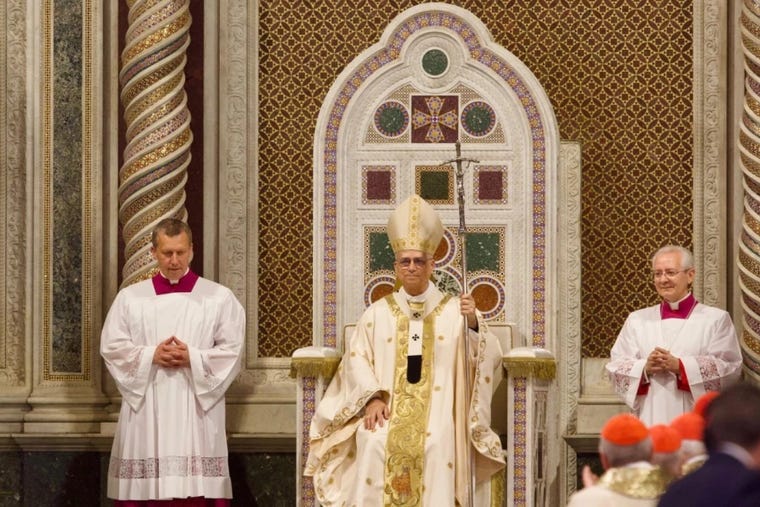
The seat of the Bishop of Rome, his cathedra, is found in the Archbasilica of St. John Lateran, clear across the city next to the ancient Porta Asinaria and the Aurelian Walls. The outside of the basilica tells you right away that this is the most important church, not only in Rome but throughout the whole Christian world:
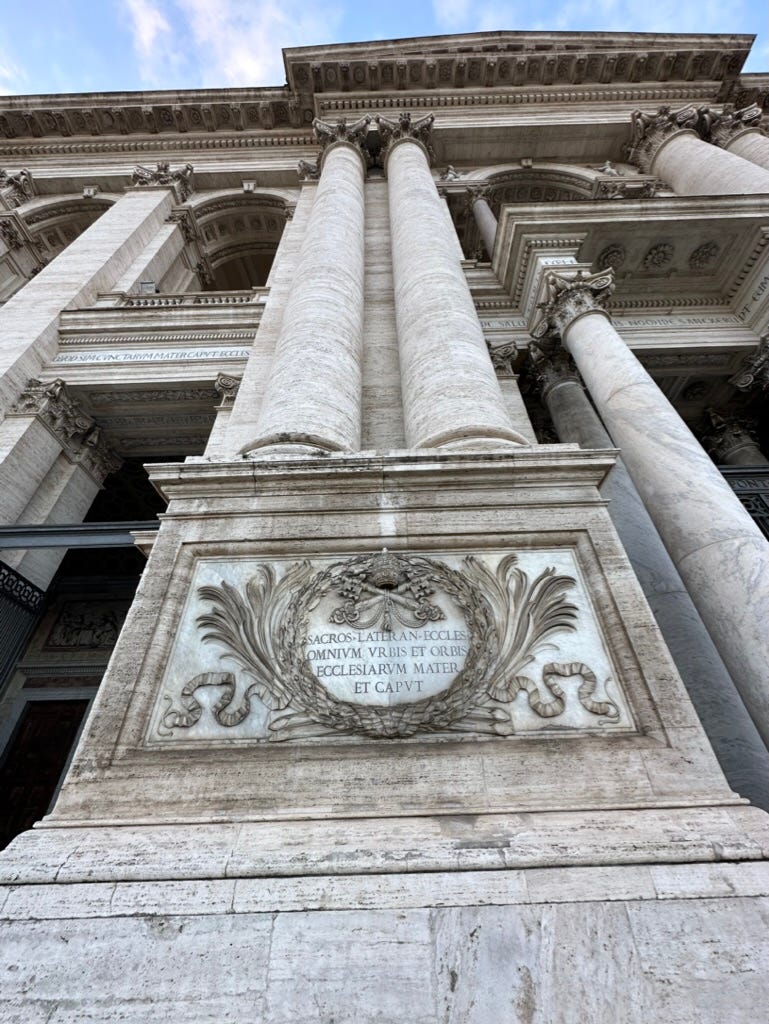
Omnium urbis et orbis ecclesiarum mater et caput: This church is the mother and head of all the churches in the city and the world.
How did the Lateran family’s palace become the site of this unique and special place?
On October 28, 312, Constantine's army met the forces of Maxentius, the emperor then holding Rome, at the Milvian Bridge just north of the city. Eusebius, who claimed to have heard the story from Constantine himself, reports a cross of light in the noon sky with the words, "By this sign, you will conquer." Lactantius tells of a dream the night before, in which Constantine was commanded to mark his soldiers’ shields with the heavenly sign: the Chi-Rho, the first two Greek letters of Christ’s name.

Maxentius had cut the old bridge in half and trusted a makeshift crossing of boats, but when his army broke, the crossing failed; he drowned in the Tiber, and Constantine entered Rome victorious.
The following year, Constantine and his fellow emperor, Licinius, met in Milan and agreed on a policy of religious toleration. Christians could worship freely, and the property seized during the persecutions would be returned. This “Edict of Milan” was a major moment in Christian history. Barely ten years earlier, the persecution ordered by the emperor Diocletian had seen churches destroyed and Christians murdered all across the empire. Suddenly, the Church that had learned to survive underground in catacombs and clandestine meetings was granted the freedom to live their faith in the light.
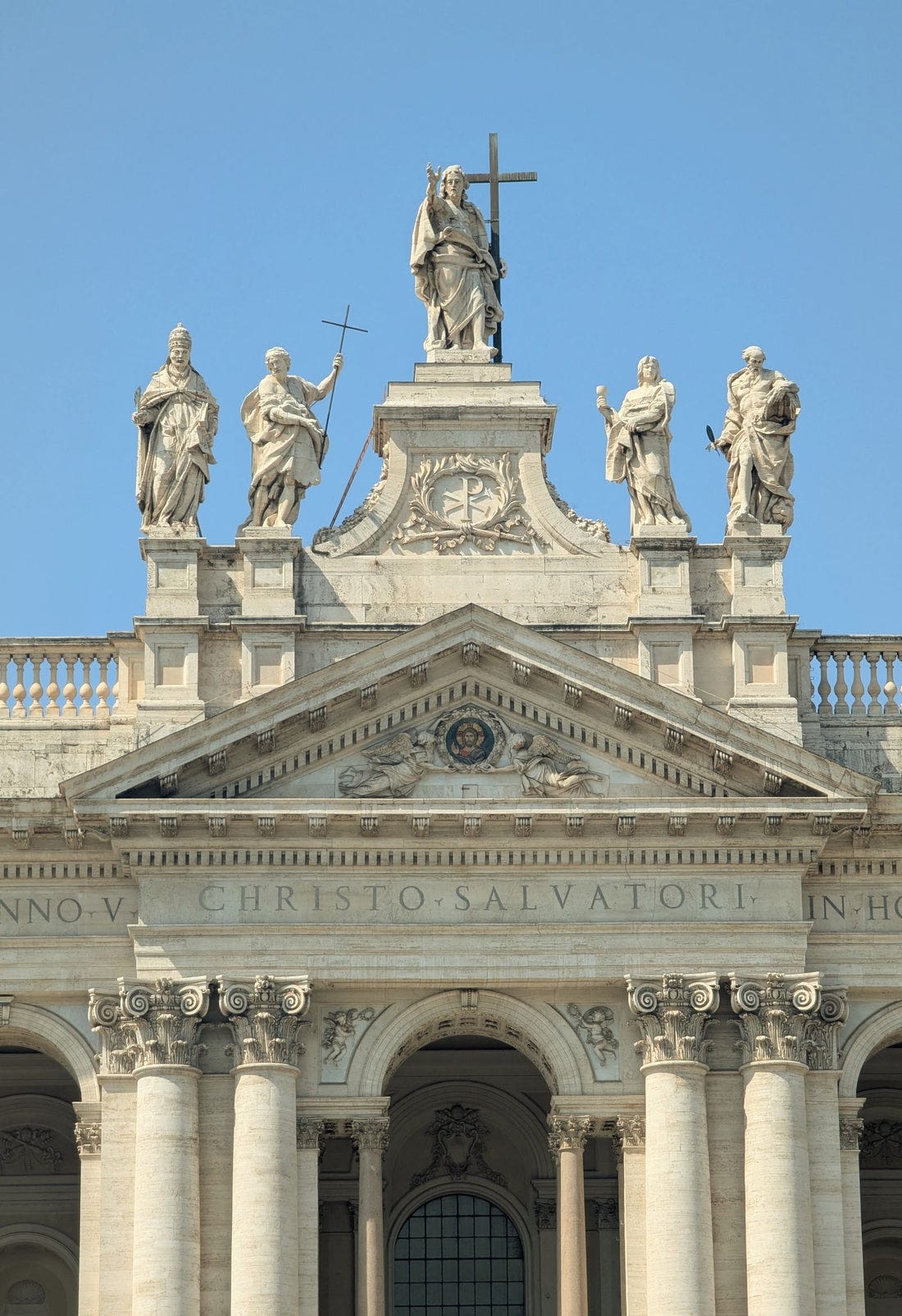
As a way to thank God for his victory at the Milvian Bridge, Constantine hoped to build a church dedicated to “Christ the Savior.” If you look closely at the top of the “modern” (1735) facade of the Lateran, you can still make out the words of dedication: "Christo Salvatore”, carved in stone beneath the Chi Rho and topped by the Victorious Christ holding his cross.
Where should the church be built?
On the edge of the Caelian Hill stood the barracks of the equites singulares, the mounted bodyguard of the emperors. These were Maxentius’s most loyal soldiers, and they had fought to the death against Constantine at the bridge. Constantine did what victors do: he disbanded the unit and demolished its barracks. Then he did what no victor had ever done. He gave the site to the bishop of Rome.
The neighboring land had passed to the imperial household long before, after Nero seized the Laterani family's property, from which comes the name “Lateran”. Tradition holds that the palace there came to Constantine through his wife Fausta, who was Maxentius’s own sister. Pope Miltiades received the property, and within a few years the great basilica of Christ the Savior rose upon it, with five aisles, furnished by the emperor with silver and gold. Pope Sylvester I dedicated it on November 9, 324.
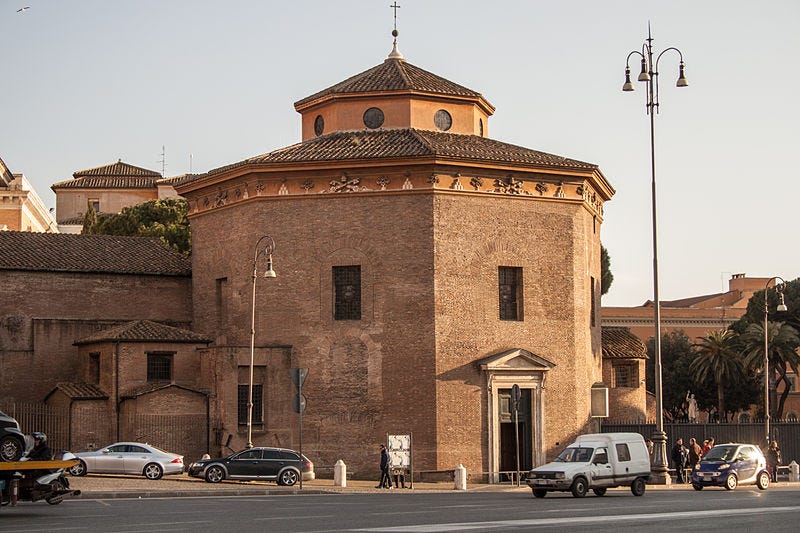
Beside the basilica rose the Lateran Baptistery, whose octagonal plan, eight sides for the eighth day of the Resurrection, became the pattern for baptisteries across the West, and which can still be visited in its original form today.
It was a fitting site for a church meant to commemorate Christian freedom in Rome, especially with the emperor's sponsorship. The ground that had housed men trained to kill for the emperor became the place where Peter's successor sat down to teach.
In August, I wrote a book report about Evelyn Waugh’s Helena. If you missed it, you can read it here.
Constantine’s mother, Helena, lived at the Sessorian Palace, about half a mile from St. John Lateran. Part of it became the church of Santa Croce in Gerusalemme, built to shelter what she brought home from the Holy Land: fragments of the True Cross, the titulus, and huge amounts of dirt from Calvary. Tradition adds that she also carried to Rome the staircase of Pilate’s praetorium, the Scala Santa, which stands across the piazza from the Lateran today.
Beautiful symmetry here: her son saw the Cross in the sky, and it won him a battle. She went looking for the Cross in the ground. His was a sign that conquered, given to a general at the hour he needed it. Hers was a wood that could be touched, found by an old woman who’d spent a lifetime looking for something concrete to see and touch and believe in.
The basilica's history through the ages reads like a tour through the Church's entire life. For almost a thousand years the popes lived next door, at the Lateran Palace, until the exile at Avignon left Rome and its churches to decay. Five ecumenical councils met there, among them the Fourth Lateran Council of 1215, which gave us the requirements for annual confession and Easter Communion that Catholics are still bound to observe. Fires ravaged the basilica in the fourteenth century. Borromini rebuilt its interior in the 1640s, wrapping the ancient columns in Baroque grandeur, and Alessandro Galilei raised the great façade in 1735.
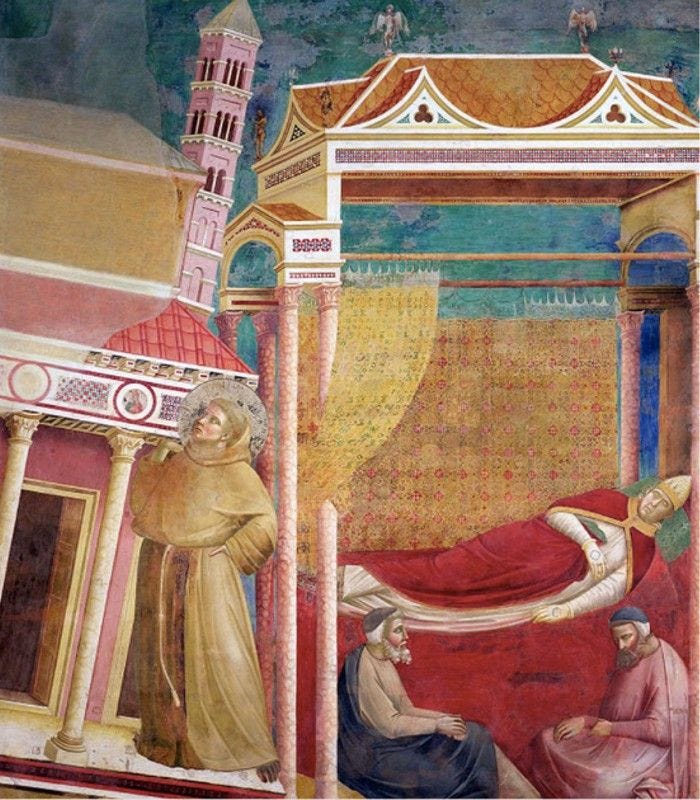
My favorite image from all those centuries belongs to Pope Innocent III, who dreamed that the Lateran was tilting and about to fall, and that a small, shabby man was holding it upright on his shoulder. He soon met that man, Francis of Assisi, and the dream is memorialized in an incredible painting by Giotto.
When you go to Rome, visit St. Peter’s and get a great guide. But do not skip the other papal basilicas, especially the Lateran. It’s the mother and head of all the churches in Rome and in the world, which means you and I have a place…not just in that physical building, but in the heart of Peter and the heart of our Mater Ecclesia, who both call St. John Lateran home.