



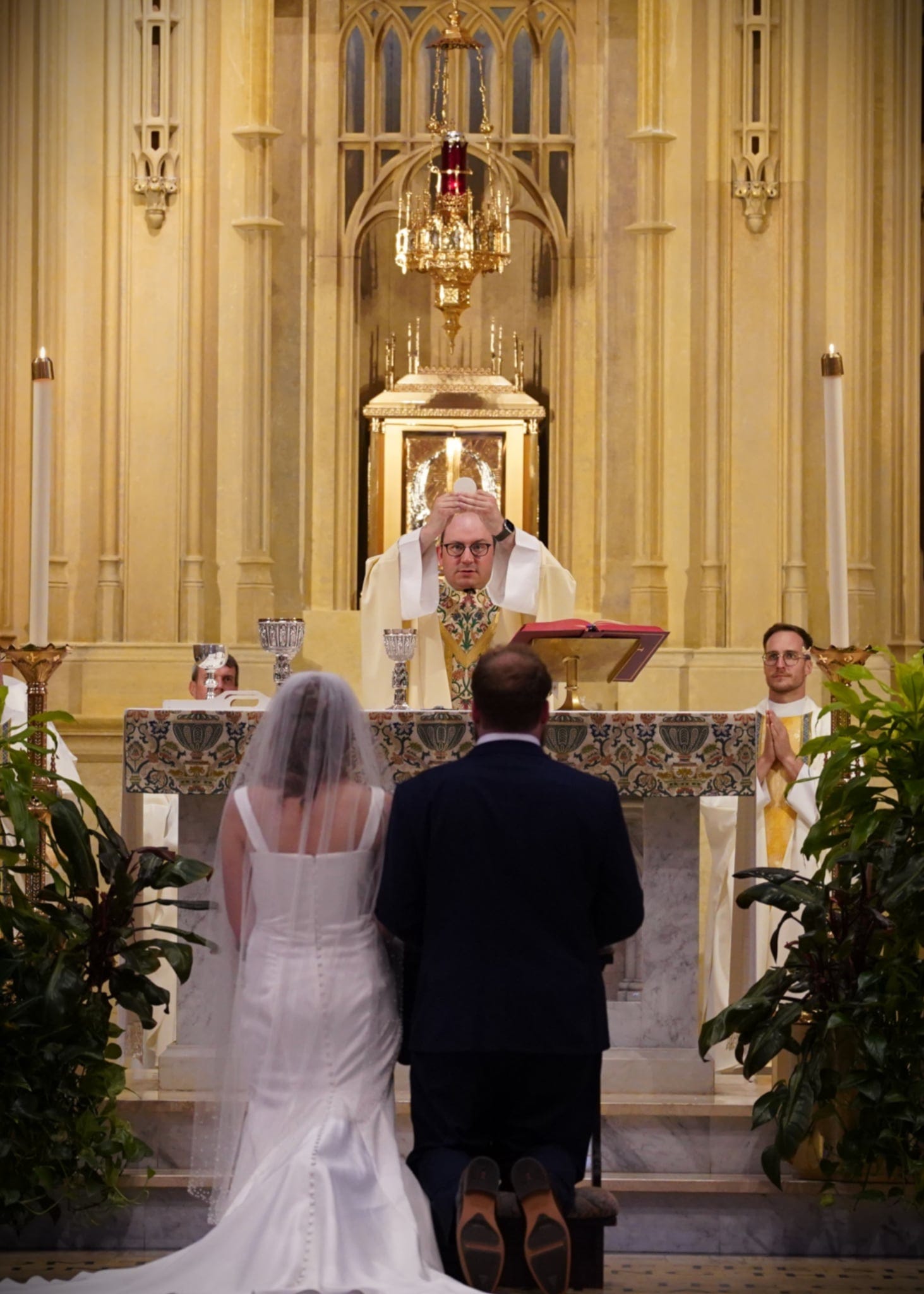
Dear family and friends who’ve come here today from quite near and quite far, dear Jack and Amanda:
I want to echo all the sentiments of joy and congratulations offered to both of you by all those who have come here this afternoon. It is truly our privilege to stand with you at this altar, this place where heaven meets earth, as we witness the two of you administer and receive the sacramental grace of matrimony.
This is a day a long time in the making. That probably goes without saying, and for everyone’s sake I won’t say any more than that. But I think does bear mentioning this afternoon is the sheer, gratuitous, unmerited, unmatchable, unquenchable, un-understandable goodness of God. God, who knows you both and loves you both and has, we believe, brought you each into each other’s lives and to this moment. Remember that “Providence” comes from those Latin words “pro” and “videre”, meaning “to see ahead”. The connotation is one of care, and timely preparation. I speak for myself, and I think for everyone else here, when I say what a privilege it is to stand with you at this moment of fulfillment and beginning.
What makes a good marriage? Or, more morbidly, what is it that makes a good marriage become a mediocre one?
The best marriages are those marriages in which the husband and wife remain friends, and view their status as best friends over and above their status as “spouses.”
In the middle of the 20th century, Poor Clare Mother Mary Francis gave her sisters a series of spiritual retreats on the topic of friendship. Friendship, she says, is “the oldest topic in the world” and also in our era “is also the newest.”
Why are we going around and around in world affairs right now, trying to find peace? Well, I suppose I could be accused of vast oversimplification if I said that it is because people aren’t friends with one another. Yet, if we could reduce the present world situation to its basics, what must we conclude? … I think we shall see that is idiotic not to be friends with one another, and this idiocy is the bedrock to world problems and community problems.
Friendship is “the common denominator to every kind of love there is.”
There is no real love that is not rooted in friendship; and when love does not seem to be functioning properly, when it is not fruitful, it is always because there is no friendship in love. You see what is wrong with a lot of marriages. Too often people live in the marriage relationship and don’t even like each other…The mere physical relationship won’t hold up. It alone is not going to help these two people mature.
Amanda and Jack, how did you fall in love?
Oh, sorry; did you all know that these two are in love? Amanda loves Jack and Jack loves Amanda. But how’d you fall in love? By first becoming friends, and having invested in this friendship, you arrived at the conclusion that from this relationship there was springing forth a mutual and deep affection, an affection the fulfillment of which can only be realized in a mutual gift of self, lasting from literally as soon as possible until “death do you part.”
Mother Mary Francis proposes that there are three elements of friendship: esteem, respect, and affection. Notice that affection comes last!
Esteem: from “aestimare” in Latin - “to determine value, to appraise.”
Respect: from “re” and “spectare” in Latin - “to look again”.
“When we have friendships with people, this is basically the reason. We haven’t looked again, and very specifically, we haven’t looked again and again and maybe again. Often we do not like the first look when we look at people, and so - that’s it. We just turn off and decide, without pondering deeply. We have an unfortunate psychological reflex in this area: we look once, say ‘no like’, and decide, without reasoning about it, of course, that we will have a different kind of relationship than friendship with this person.”
Affection: from early French “affeccioun” - “a desire, an inclination, a disposition/openness”
After looking again and again, and liking what we see, there’s an inclination, a leaning in toward this person and all that they have shown.
Consider how St. Thomas Aquinas describes the process of falling in love: first knowledge, then affection; then desire for more knowledge, then increased affection. You cannot love what you do not know and the more you know, the more you can love.
Adam in the Garden - looking at all of creation, naming it, knowing it in an incomplete way. What was his first look at Eve like? Did he initially pass over her? Did he do a double-take? What estimation did he make of her in those first moments? Whatever his first impression, it’s when he looks again at her that he makes the decision to pursue her. All the other created things are nice - indeed God even calls them good - but none of them are for him in the way Eve is.
This one at last is bone of my bones and flesh of my flesh.
He respects her; literally, he looks at her again and, as Mother Mary Francis advises, again and again and what does he find? He no longer sees just another creature, just another animal, but he perceives in her what he perceives in himself: the image and likeness of someone else, a unique personality, a personhood not made to imitate his or to become identical to his, but to complement his. This bone of his bones and flesh of his flesh is given to him so that by knowing each other - living as companions with one another - each may become fully what they’d been created to become.
Often, our estimations are hasty; they end up leading us astray. This is how we can create all kinds of theories and sAmandaes about people we barely know; it’s how friendships and marriages get all out of whack - I make a judgment about something, draw a conclusion without being sure my judgment has anything to do with reality, and then forget to look again at the person so that eventually, in my mind, the person and their action become inseparable.
Friendships - all relationships, actually, but especially friendships and especially marriages - get stale and dry when you stop looking again and again for the person at the heart of it all.
Gratiam supponit naturam et perficit. If I had a line of priestly merch, that would be all over t-shirts and hats.
Gratiam supponit naturam et perficit. Grace presupposes nature and perfects it.
Marriage already existed before Jesus turned water into wine during the wedding feast in Cana. Marriage is what’s called a “natural institution.” But like everything in the Christian life, Jesus takes something that is natural and good, infuses it with his grace, and makes the original thing even better but also transforms it totally so that it can become a vehicle for salvation, yes, in the long run, but even in the short term he uses the grace of the sacraments to make life here a bit more bearable. Jesus promised his disciples life and life in abundance, and it’s through living a sacramental life - a life in which the power of God is allowed to seep into every nook and cranny - that we will find the means and courage to live the most fulfilling possible life here below and also be maximally prepared to get each other and your children to the life beyond.
Amanda and Jack, the complete union of persons is not always going to be easy.
The complete union of persons is only simple and without strain for God. Human relationships, as we know, are fraught with complications and sometimes pain. But difficulty is necessary for knowing the full value of love, and loving another person in truth, in vulnerability, and in total self-gift is always worth the risk.
Jack and Amanda: love is always worth the risk. Difficulties do not surprise God, and that’s why we’re able to say that grace presupposes nature; the grace of the sacrament you will minister to each other today takes into account the fact that marriage is funny, and relationships are odd, and even the best of friendships can be hard sometimes.
But when the natural inclination is to say “get out of there! Get revenge! Hold that grudge! Leave that bowl in the sink one more time jusssttt because!” It will be the voice of the Holy Spirit, speaking through the power of the grace of this sacrament that says, “LOVE! Love requires sacrifice but it’s always worth it! Look again! Look again and again and again until you see the person within your spouse, the person, the best friend who you married.”
Jack and Amanda, the prayers of all of those gathered here can be summed up in this way:
May God bring to fruitful completion what today is so wondrously begun in you.


