
I started kindergarten in 1997, and I went to school every single year until I finished graduate school in 2020. That’s twenty-two consecutive years of formal education. 22nd grade.
I went to public school my entire life until the seminary, and public school taught me many things. What to do, how to be a decent citizen. But I cannot say, with any honesty, that it taught me to love school, to be curious about study. In high school in Oswego, we had block schedule: four periods a day, each ninety minutes long. My second semester of senior year looked like this. First period: I worked in the school office, answering phones, running notes between classrooms, and eating candy. Second period: bowling. We drove to the bowling alley every day…an endeavor that was not without its fruit: for my final exam that year I bowled a 290. Third period: band, or choir, depending on the day. Fourth period: an actual class. History, maybe? English?
Then college, where I studied English because I wanted to be a high school English teacher, and this was difficult because I discovered that I hated to read and write. And then, as a college sophomore, I transferred to my first Catholic school, the seminary. Graduate school after that. Ordination in 2018. And then, of my own free will, more graduate school.
Why would I do that? Why would I cross the finish line and then voluntarily go back?
Because when I finally started studying theology, something clicked that had never clicked before. A whole new world opened up, filled with wonder. Every answer I found opened up fifty more questions. I loved reading about it, writing about it, thinking about it, preaching about it. For the first time in twenty-two years of school, I had found something that made my heart and mind come alive at the same time.
That’s what learning is supposed to do. That’s what it’s for.
You might look back on eighth grade someday and find that you don’t remember very much about it, or that what you remember has nothing to do with school. That’s okay! That’s probably right, actually. The years of formation are years to be coped with as much as cherished. Take out the trash. Do your homework. Come home on time. We all went through it.
But our prayer for you is that your life will not merely be coped with. That somewhere ahead of you, you will find whatever it is that makes your heart and your mind connect. For some of you it will be theology. For some it will be law or medicine. For some it will be the particular and underrated joy of family life. For some it will be a craft, a sport, a challenge you haven’t yet encountered.
Deacon Sam and I got a real kick out of reading your twenty-year plans in the yearbook. A few things stood out. First, how many of you looked forward to finding love and building families. The fact that you desire that is not nothing, and it says something good about your own families and experiences of life thus far. Second, how many of you said you wanted to move back to Elmhurst and even Visitation, which says something equally good about the way your parents have raised you. Third, way too many of you are counting on a Butterfield membership. I hope you’re able to achieve that! And finally, so many of you wrote about leaving room in your homes for other people, about maintaining the friendships sitting in this room right now, about building lives with space in them for the people you love.
Whether all of that comes to pass exactly as written or not, it is a real testament to what you have learned during your time here. The fact that you can imagine your life that way at all means something.
I am leaving in August, which means that you and I are both graduating from Visitation this year. I’m headed to 23rd grade: Canon Law at The Catholic University of America, six semesters straight through, summers included. I’ve never studied it before, so we’ll see how it goes!
But here is what I have learned, looking back across twenty-two years of school:
In finite mathematics at North Central College, I received a C-minus. That is Math 100, for the record. And that C-minus was after a semester of make-up tests, meeting with the professor, crying over calculators, and stressing out. Do you know how many times someone has asked me about that grade in the years since? Not once. Nobody has ever asked. As we used to say in the seminary: what do you call a priest who got a C in math? Father.
It was never about the grades. It was never about which study groups clicked or which relationships lasted or which tests I aced and which ones I failed. All of that shaped me, and I’m not dismissing it. But it was not the point.
Your Christian faith is not ultimately a what. The question of your life is not what you will do, because that will change, probably many times, in ways you cannot predict from where you’re sitting right now. I could have been a priest or a lawyer or a doctor or a farmer or a plumber or a trombone player. Many things were possible. The what is not the point.
The question is how. How you do it. How you live it.
Can you be the same person in a pew as you are at your desk? The same person on the street as you are at home, in a restaurant, in a difficult meeting, in a moment when no one is watching? That integration — that consistency of character across every context — is what the Christian life is actually asking of you. It is, in the end, what sets people apart. It is what makes someone worth working alongside, worth building a life with, worth trusting when things get hard.
Do not let your academic study get in the way of your education. Your real education — in virtue, in humility, in kindness — your growth into a person filled with goodness and truth, who goes looking for what is just and loving in every person and every situation: that is what will matter. Not the transcript.
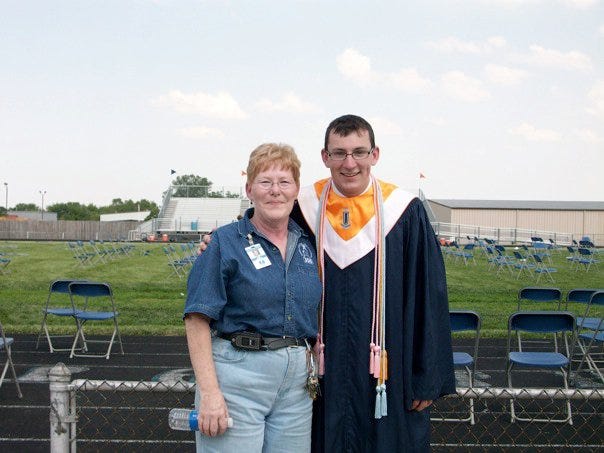
I remember my own eighth grade graduation as a tremendously joyful day. I received the American Legion School Award — Traughber Junior High, Class of 2006 thank you very much— and I remember being proud of that. I don’t remember much else.
And I hope that someday you look back on today and find that it has become, in memory, a little soft around the edges. Not because it isn’t significant, because it sure is, but because that softening is a sign that even greater things have come after it.
Today, you are as old as you have ever been. And today, you are as young as you will ever be again.
And that is something you can say every day of your life, and it will always be true. It means: it is okay that you know what you know and don’t know what you don’t know, because you have never done this before. And it means: don’t waste the moment you’re in, because this particular moment — this age, this version of yourself, this exact configuration of people and possibilities — will not come again.
So celebrate today. Be present to it. And then step forward with confidence, not because you have everything figured out, but because you are loved — by God, by the people in this room, by people you haven’t met yet — and that love does not depend on your having everything figured out.
Over all the years of my priesthood, across four assignments, too many semesters of graduate school, and in every unexpected turn the road has taken: God has never let me down. There have been moments where I’ve said, what exactly are you doing!?, and could we perhaps discuss this more collaboratively!? But he has never led me astray.
The Lord has been my light. He is yours as well.
I know I speak for your parents, grandparents, siblings, and friends who are here when I say that our prayer for you tonight is simple. It’s a prayer we pray with everything that we have, because we have come to know you and love you and believe in you:
May God bring to fruitful completion what today is so wondrously begun in you.
Amen.