



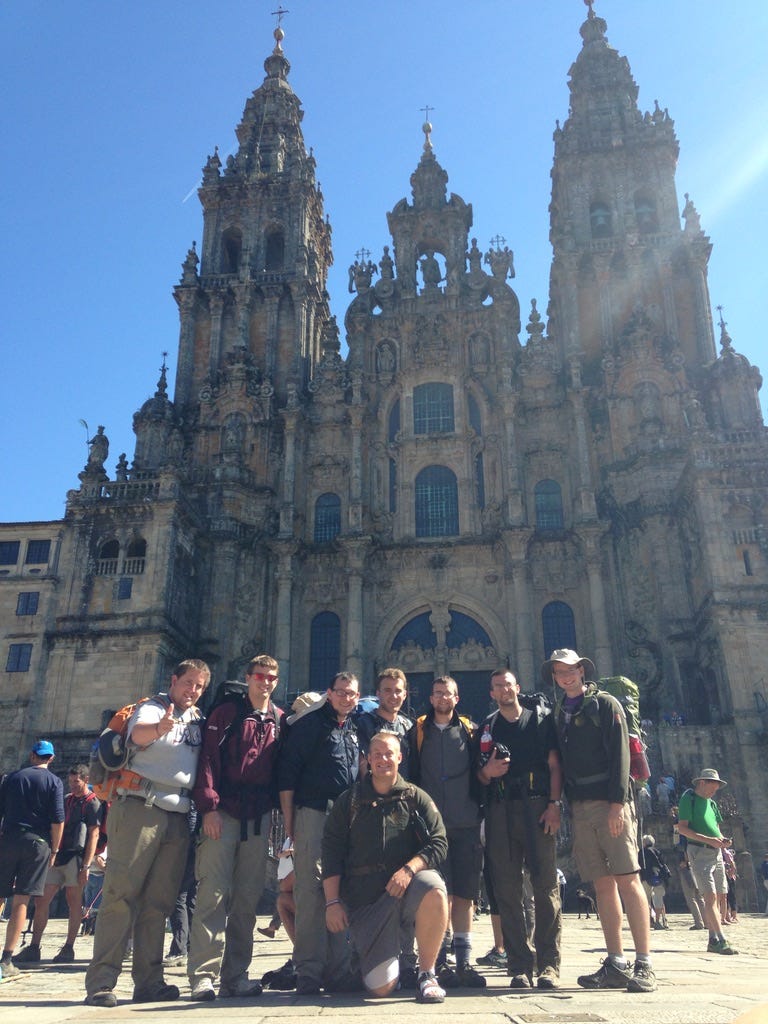
When you start a new job, there’s usually a period of adjustment before you’re trusted to operate on your own. A probationary period. A training period. If you’ve ever worked as a server, you know the specific humiliation of following someone around for a week, watching them take orders, pretending that writing things down on paper is, in fact, a learnable skill. If you come from a family of tradespeople, maybe someone went through an apprenticeship before they were allowed to pick up the tools unsupervised. In religious life, monks and sisters go through a novitiate — sometimes a year, sometimes many — before they’re professed.
In life, there’s always a learning curve. That’s just true. We are never as good at things immediately as we want to be.
One of my favorite quotes of all time comes from a sign on the wall at Jimmy John’s: If you do the things you need to do when you need to do them, then someday you can do the things you want to do when you want to do them.
Put in the work and you’ll see the results.
What I find interesting is how rarely we apply this kind of common sense to the life of faith. We get discouraged when we’re not immediately good at prayer. We get down on ourselves when we can’t easily hear the voice of God, or figure out his will, or treat the people around us with the patience and generosity we know we’re capable of showing. It can feel like evidence of some fundamental failure.
But the Catechism of the Catholic Church uses this exact word — apprenticeship — to describe the growth of the Christian life. An apprenticeship of self-mastery, of integration over time. The project of Christian living is a slow, ongoing reconciliation of all the different parts of a life: what you’ve done, what has been done to you, the facts of the world as you’ve found them, and the proposal of the Gospel. It takes time. That’s not a bug in the system, requiring a downloadable patch. That’s the design.
Read It Differently
Today’s gospel — I am the way, the truth, and the life — is one of the most famous lines in all of Scripture. We know it so well that we might not actually be hearing it.
The Greek word John uses for way is hodos. You don’t need to remember that. But it’s worth knowing that hodos doesn’t just mean a road. It’s a “means of access, an approach, an entrance” — a way of getting into something. It’s also used not just for the beginning of a journey but for the journey itself: a systematic pursuit, a course of action, a way of conducting oneself that belongs to something larger.
This is why, in the Acts of the Apostles, the earliest Christians weren’t called Christians. They were called followers of the Way. The word Christian only comes later, coined first in Antioch. Before that, the identifying mark of this movement was simply: these are the people who follow the Way — meaning this person, Jesus, who is himself the road you walk and the gate you enter and the destination you’re headed for, all at once.
Not Just You and Jesus
We’ve become very attached in modern Christian life to the language of personal relationship with Jesus, which is obviously not wrong; Jesus himself says in John’s gospel: I have called you friends. A genuine friendship with Christ, a personal attachment to him, is not optional. Something real is missing without it.
But here’s the danger: if your entire Christian life is just you and Jesus, with no Church, no community, no teaching, no accountability, you might ask yourself an honest question: is this actually a relationship with someone outside you, or have you quietly made God in your own image?
If your God lets you do whatever you want, your God is probably you. And then what you have is, essentially, the anti-Trinity: you, talking to you, about you, and calling it prayer.
A personal relationship with Jesus is a real thing. But it’s a personal relationship that is ordered toward conversion, for the sake of a kingdom, with lots of other inhabitants and concerns. Jesus didn’t come to make us feel validated. He came to establish something. And we are invited to participate in that, which means being changed by it.
Nothing Is Censured
One of the marks of a genuinely Christian way of seeing the world is this: nothing is censured.
What I mean is this. A huge amount of human suffering comes not from circumstances themselves but from the story we tell about those circumstances: this shouldn’t be this way. He shouldn’t have done that. I shouldn’t have turned out like this. The world shouldn’t be so broken.
Well — who said?
Perhaps the hardest thing Christianity asks of us is to look at the world and our lives exactly as they is, take them seriously as real, and stop fighting reality as though, if we push back hard enough, we can make it into something it isn’t. When we spend our energy resisting what’s actually true about our lives, we turn to other things to cope: wealth, pleasure, power, the endless distractions of a world that will always eventually disappoint us.
The Bowling Coach
I want to offer you an image, and I will warn you in advance that it is extremely cheesy. But since it’s cheesy, it means you’ll remember it.
You and I are terrible bowlers. We’ve decided to hire a coach, and his name is Jesus.
He is very gentle about the whole thing. He says, have you tried putting your fingers in the holes? Because the holes are there for that. Have you considered your stance? Let’s work on your follow-through. I know it’s uncomfortable — it’ll require a change, maybe just a small one, one millimeter this way, one centimeter that way. Let’s try throwing it underhand and see if that helps. We’ll figure this out together.
And then, to our slight embarrassment, he also goes ahead and puts up the bumpers.
On the bumpers of the lane, if you look closely, you’ll find words written there. The sacraments. The Church’s teaching. Christian fellowship and community. Catholic social teaching. Your family history and the people who have prayed for you. The saints. Grace. The power of the Holy Spirit. It’s a very long lane, and there are a lot of bumpers.
But this is the point: as you roll your little ball through life, you have all of these things to bounce off of, to keep you on the narrow way — the hodos — rather than careening into the gutter. Wide is the way that leads to destruction, as Jesus says elsewhere. Narrow is the way that leads to life. And he is the way, and he is also the coach, and he is also the one who built the lane.
You have to want the help. You have to ask for it. And you have to accept that it will take, like everything else worth having, a very long time.
One Throw at a Time
A Dominican theologian from the fourteenth century, Meister Eckhart, puts it simply: Do you want to be holy? Then start by doing the next thing you do in a holy way. Say the next thing you say in a holy way. Think the next thought. Take the next step.
This is also, essentially, Aristotle’s whole theory of virtue: if you want to have a virtue, act as if you already have it, and eventually you will. It sounds like “fake it till you make it.” That’s because it is. Aristotle got there first.
The practical version is this: before you send that text, before you say that thing, before you react the way you’re about to react — pause and ask: Would a person who genuinely loves God do this? Is this what freedom looks like?
Not: am I allowed to do this? But: is this consistent with who I am trying to become?
And if the answer is no — backspace. Walk away. Take a breath. One decision at a time. One throw at a time.
You’re going to get it wrong. I’m going to get it wrong. But we have a coach who shows up to these lessons without fail, ready to look at the tape and say: last week had some bright spots, and also some areas for growth. Let’s start there. It’s usually the area you least want to start in. But that’s where the work is.
The saints are not people who came out of the womb bowling strikes. They’re the people who stayed in the bowling alley. Who kept showing up to the lesson. Who, over years and decades, learned to do the things they needed to do, until someday they could do the things they wanted to do.
There are joys along the way. There are Bosco sticks and questionable bowling alley fries. It is not a joyless road. But it is a road, and it runs in a particular direction, and it asks something of us.
If you do the things you need to do when you need to do them, then someday you can do the things you wanna do when you wanna do them.
It's pretty much as simple as that.


