



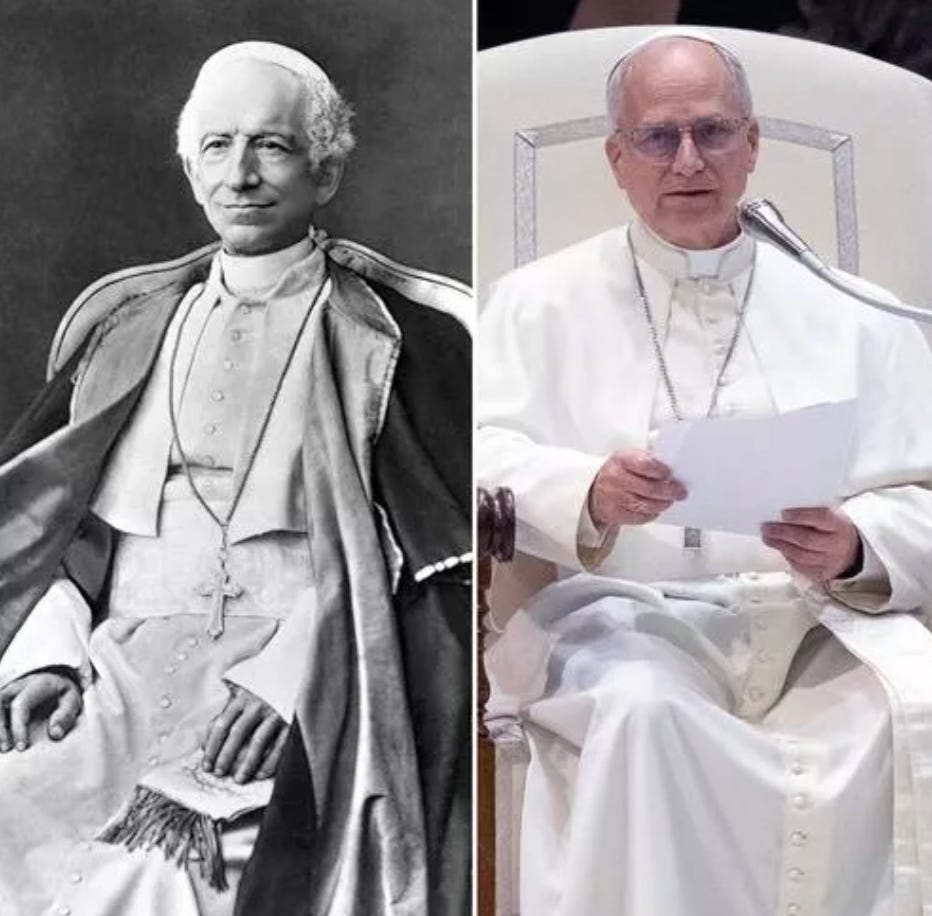
You can find Pope Leo’s encyclical letter here.
This past Monday, Pope Leo XIV released an encyclical letter — a papal teaching document that takes its name from the Latin encyclica, meaning it cycles the globe, addressed to all members of the Church and to all people of goodwill everywhere. This one was about artificial intelligence.
A lot of people assumed the Pope would simply condemn AI and be done with it. He does not do that. What he does instead is something more interesting: he uses the occasion of this encyclical to offer a sweeping restatement of Catholic social teaching: its foundations, its pillars, and why those pillars matter for how we build technology, structure economies, and treat each other in daily life.
When a papal encyclical comes out, it’s easy to learn about it from the news, from podcasters, from commentators and influencers of various kinds. But the letter isn’t written to them. It’s written to you and to me. And so it’s worth knowing, at least in brief, what it actually says.
The Four Pillars
Catholic social teaching is sometimes dismissed as political, as the province of one ideological camp or another, depending on which parts make you uncomfortable. Remember, it belongs to no party. It answers to no faction. Catholic Social Teaching simply asks what society could look like if it took the Gospel seriously.
When I was teaching high school moral theology, I used a handout called “The Catholic Social Teaching Hut”. Look below!
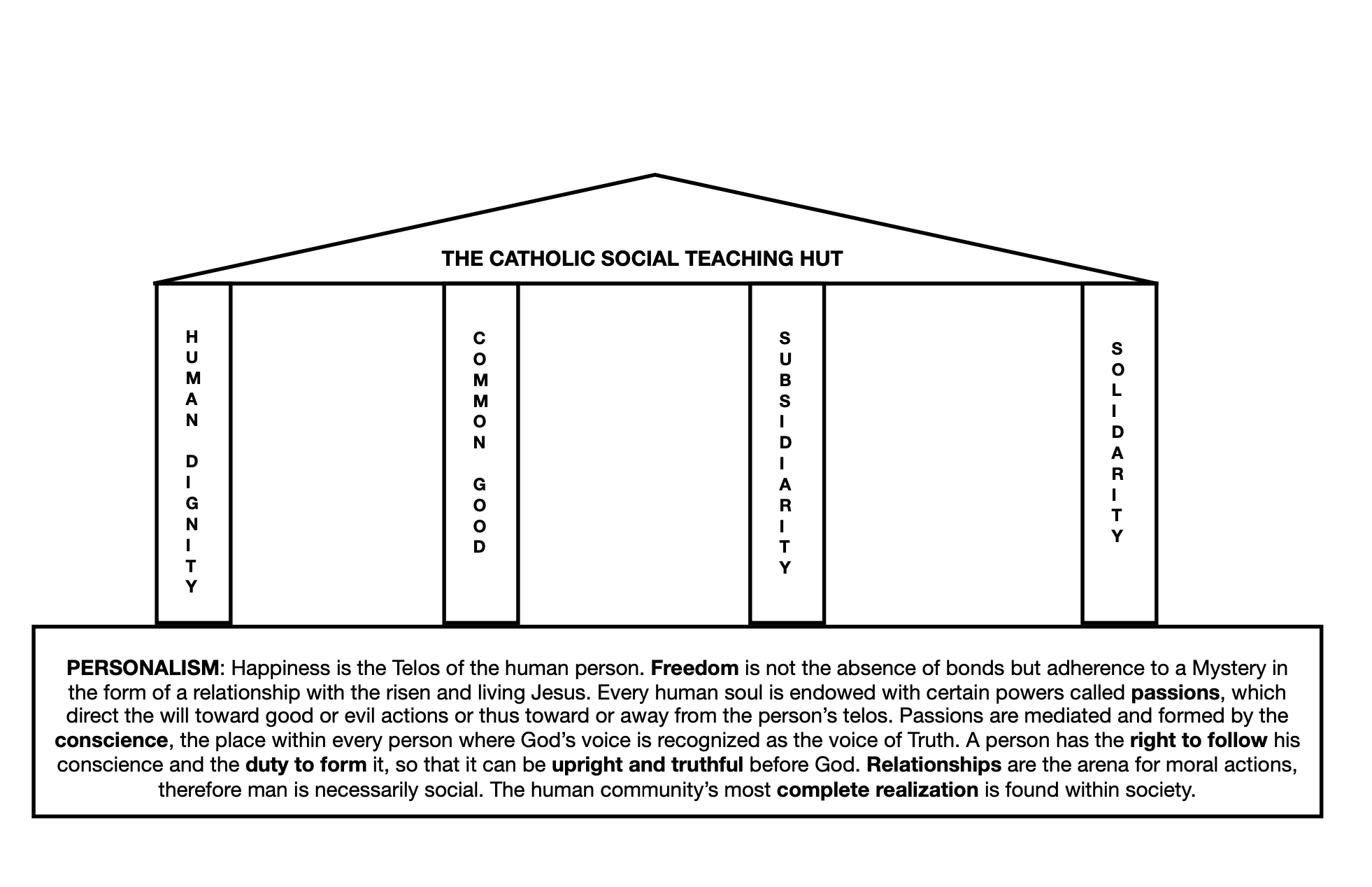
The Pope walks us through each of these pillars.
First: the dignity of the human person. This is the umbrella under which everything else falls. It includes, yes, the rights to life from conception to natural death. But human dignity extends far beyond the debates we’re accustomed to associating with it. Leo XIII, writing at the end of the nineteenth century amid the upheaval of the Industrial Revolution, was already applying it to the dignity of workers. It applies to reputation and how we speak about people. It applies to the interior life of the home, where dignity can be violated through silence, passive aggression, or the slow erosion of trust.
Human dignity is not simply a matter of the great bioethical questions, as important as those are. It is a question that arises every time I am in the presence of another person: if this person is a living image of the living God, how does that change how I speak to them, how I speak about them, what I do with them, and what I expect from them?
Second: subsidiarity. It’s a large word for a simple idea: that problems should be handled as close to the people involved as possible, at the most local level capable of addressing them.
You’ve probably experienced what a violation of this principle feels like. Imagine you have a cubicle neighbor whose music is a bit too loud. The right move — the human move — is to walk over, introduce yourself, and say something about it. Maybe they had no idea. Maybe it gets resolved in thirty seconds. But now imagine you said nothing, and one day your phone rings and it’s someone from HR informing you that a complaint has been filed, that it’s now in your permanent record, and asking you to come down and sign a performance improvement plan.
That feeling — that strange violation — is subsidiarity being ignored. It’s what happens when a problem that belonged between two people gets escalated past them, above them, around them. The same principle applies when a neighbor calls the police over your Christmas lights rather than knocking on the door. The same principle applies whenever the machinery of large institutions gets invoked to solve problems that two people and a conversation could have handled.
Third: solidarity. We are in this together. Not as a sentiment, but as a fact. Your grandmother’s version of this was probably something like: everybody puts their pants on one leg at a time. The most powerful person in the room and the person with the least advantage in the room are, before God, exactly the same. We make life harder for each other than we need to.
Dorothy Day, the great Catholic social activist, was often asked why she did the work she did with the poor and with workers. Her answer was simple: I believe we have made things harder than God intended them to be. We need to make it easier for people to be good. That was it. Not a policy platform. Not an ideological program. Just: we should arrange things so that it is easier, not harder, for people to be good to each other and to themselves.
Which brings us to Day’s other great line, perhaps her most famous: Everybody wants a revolution, but nobody wants to do the dishes.
Fourth: the common good. On May 29th, the Church celebrated the feast of Pope St. Paul VI, who gave us one of the great one-liners of modern Catholic social thought: If you want peace, work for justice. Justice, in its strictest sense, simply means giving the other what they are owed. To render to God what belongs to God, to render to Caesar what belongs to Caesar, and to render to my mother-in-law what is owed to my mother-in-law. To render to my parents the respect and openness that their role deserves. To render to my child the freedom they need to grow — while also, yes, holding the line on a 10 p.m. curfew, because a relationship of trust is also something owed.
The common good is not a transaction. The goal is not a world of perfectly balanced ledgers. But it does require asking, honestly, what do I owe other people, and what do they owe me…and then actually doing the dishes when it’s time to do the dishes.
There is a practical application.
I am a human being — possibly you had noticed — and I too have people in my life who occasionally drive me to the brink. I will sometimes find myself composing a text message to a priest friend about some situation in the parish or in my personal life. And the text is genuinely good. It has everything going for it: it’s funny, it’s well-crafted, it makes its point with precision and verve. It might win a Pulitzer Prize.
It is also, if I’m being honest, completely disparaging of another person, and it could live perfectly well between me and God and never need to involve anyone else. So then rethink, bounce this action off of what I believe to be true about interacting with others in a way informed by the Gospel, and I backspace. Bye bye Pulitzer, but hello peace.
That is what I mean by a filter. I’m suggesting that every day contains moments… in the home, at work, in traffic, in the kitchen… where human dignity, subsidiarity, solidarity, and the common good are genuinely at stake. When you feel those things being violated against you, the same pillars give you language and courage to advocate for yourself and for others. When you’re the one doing the violating, they ask you to stop.
Mend your ways, Paul says in today’s second reading. Encourage one another, agree with one another, live in peace. It’s not as simple as just deciding to agree. But it is as practical as putting down your phone, going over to the person, and having the conversation that needed to happen three weeks ago.
The icon here on the ambo this week is an image of the Holy Trinity, depicted as three divine figures seated together at a table, a meal before them. It’s based on the famous icon by Rublev, and it is my favorite image of the Trinity, partly because it’s one of the few that doesn’t immediately make you a heretic to contemplate. (Trinity Sunday is, for the record, the single hardest Sunday on which to preach, because the easiest thing you can do is accidentally say something that was condemned at a Council in the fourth century.)
In this image, the Father, Son, and Holy Spirit are united at a banquet, each fully present, each fully themselves, completely transparent and open to one another, and yet maintaining the total individuality of who they are. They are not merged. They are not in competition. They are in communion.
Remember in Genesis, God says Let US make man in OUR image (Gen 1:26) that us in Genesis is the whole Trinity, creating together, with this image in mind. Not division, but communion. Not rigidity or selective generosity, but the kind of love that gives freely and expects that it will be received and returned.
If you want peace in the world, work for justice. If you want peace in your home, work for justice — which means, yes, getting off the couch sometimes; yes, being ready to leave when you said you would; yes, letting him go out on Friday because he’s seventeen and you cannot follow him with water bottles and sunscreen for the rest of his life; yes, being willing to set aside what you want to keep for yourself if keeping it prevents the full flourishing of the person in front of you.
Not because you’re required to. But because that’s what love does.
It’s interesting, isn’t it, that the Pope chose to spend almost half of an encyclical on artificial intelligence on Catholic social teaching? Half the document — devoted to these pillars, to human dignity and subsidiarity and solidarity and the common good.
He’s trying to say something. The question of how we build and deploy new technology is not, at its core, a technical question. It’s a human one. And if we can learn to run our decisions — all of our decisions, not just the ones about AI — through the filter of these pillars, we might find, not automatically but organically, something that looks a little more like the communion the Trinity imagined for us at the very beginning.


