



Deacon Sam Bergmann is a transitional deacon for the Diocese of Joliet, and will be ordained to the priesthood in June 2026. He currently serves at Visitation Church in Elmhurst.
One of the longest-running ministries I have had here at Visitation has been bringing Holy Communion to Park Place, one of the nearby retirement homes just behind the hospital. For about a year and a half now, I have gone there regularly with a ciborium full of hosts, celebrating a brief communion service for the residents and then going room to room—often with one of the sisters—to bring the Lord to those who are no longer able to leave their beds.
It is a ministry I have come to love deeply. I sometimes joke with the residents that they were my first parishioners, since I began leading them in prayer and preaching to them long before I was able to do so at Mass as a deacon. But like many things in priestly life, it is not the big moments that remain with you so much as the small, quiet encounters that linger long afterward.
At the beginning of Lent this year, I went to Park Place on Ash Wednesday to distribute ashes. By that point, I had already given ashes to several hundred people, but it was very different walking into those rooms, especially the rooms of those who were very sick. When I came to one elderly woman whom I had visited regularly—a small, bedridden woman who had not left her room in months—I traced the cross on her forehead and said the familiar words: “Remember you are dust, and to dust you shall return.”
She looked up at me, smiled slightly, and said, “Well, that’s a cheerful thought.”
She meant it as a joke, and I laughed with her. But as the days of Lent went on, that phrase stayed with me. It returned again and again, as if it were asking to be taken more seriously.
Because of course, it is not meant to be a cheerful thought.
The Church does not place ashes on our foreheads and remind us of our death in order to make us feel lighthearted. It is not trying to cheer us up. And yet, it is something profoundly Catholic.
We live in a world that increasingly confuses cheerfulness with joy. Any experience of suffering, sadness, or loss is often treated as something inherently negative, something to be avoided or minimized as much as possible. Without the horizon of the resurrection, life easily becomes a kind of frantic effort to maximize pleasant experiences and eliminate painful ones—to remain cheerful for as long as possible and to suppress anything that might disturb that illusion.
But such a life, in the end, becomes hollow. When half of the human experience is rejected or feared, even the other half begins to lose its meaning. Trying to live without sorrow or suffering is like trying to celebrate Easter without ever acknowledging Good Friday. It is like standing before the empty tomb without recognizing that, at one point, the tomb was not empty at all.
Christian joy does not come from avoiding suffering. It comes from passing through it with Christ.
To live with Christian hope does not mean walking around with a constant smile, as though faith were a kind of emotional insulation from the realities of life. It does not mean living in a perpetual Easter. It means living as Christ lived—embracing both the cross and the resurrection, knowing that one leads to the other.
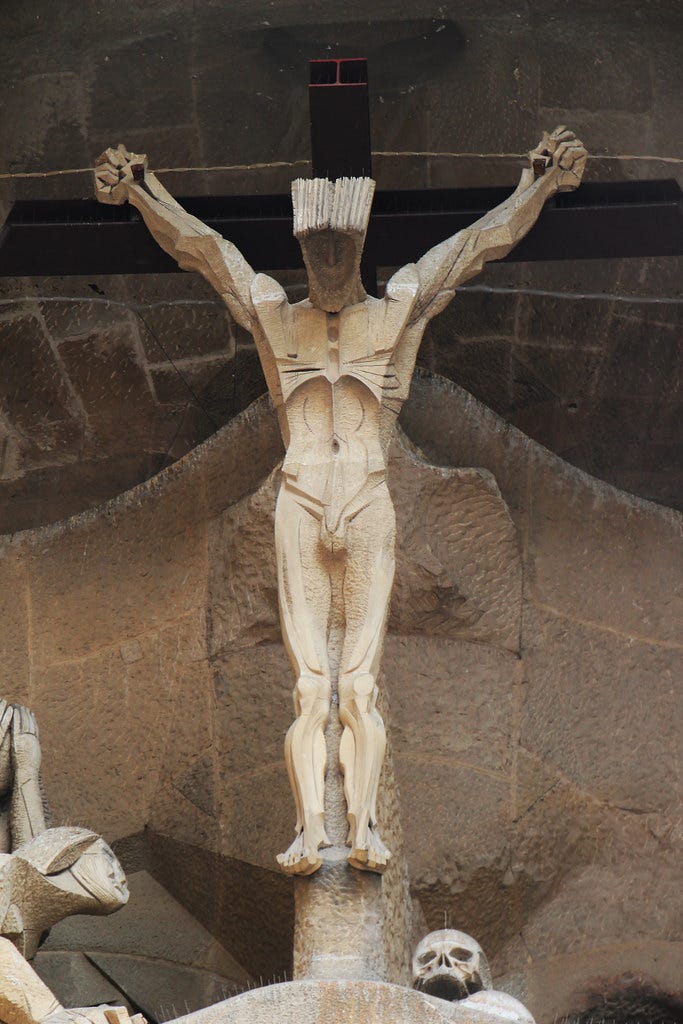
Today, the Church asks us to remember the most terrible suffering the world has ever seen. We remember an innocent man—the only truly innocent man—condemned to death as a criminal. We remember the Lord of life hanging on a cross. And somehow, in the face of all of this, we call this day Good Friday.
And the truth is, we understand that.
We understand, at least in some measure, why this day can be called good. We recognize that in the suffering of Christ there is something more than suffering. We hear the words of the prophet Isaiah describing a man “spurned and avoided by people, a man of suffering, accustomed to infirmity,” led like a lamb to the slaughter, and we recognize that through His suffering, many are justified. By His wounds, we are healed.
We know that this Friday is good.
But the more difficult question is whether we can say the same of our own Fridays.
Perhaps the most difficult step in the Christian life is moving from recognizing the goodness of Christ’s cross to recognizing the presence of that same goodness in our own suffering. It is one thing to venerate the cross. It is another thing entirely to carry it.
And yet, the claim of Christianity is precisely this: that Christ is not only present in His suffering, but in ours.
He is present in the small irritations of daily life, in the anxieties that keep us awake at night, in the disappointments that weigh on us, and in the moments when we feel most alone. He is present even in those moments when we might be tempted to echo His own words from the cross: “My God, my God, why have you abandoned me?”
He is present there—not to remove the suffering immediately, but to transform it from within.
This is why we are able, eventually, to call even our own Fridays good. Not because suffering itself is good, but because we are not alone in it. Through His cross, Christ has entered into every dimension of human suffering and has made it a place of encounter.
Without the cross, the world is correct to say that suffering is meaningless and should be avoided at all costs. Suffering, by its nature, isolates. It is deeply personal, often incommunicable, and at times unbearable. But with the cross, suffering becomes something different. It becomes a place where communion is possible—where we meet Christ most intimately.
This is what the Church means when she speaks of the redemptive power of suffering. It is not a call to forced positivity or superficial piety. It is not the naïve suggestion that we simply “offer it up” and pretend everything is fine. It is an invitation to discover that Christ is already present in our suffering, and to unite ourselves to Him there.
When that happens, even the darkest moments of our lives begin to change. They do not become easy. They do not become painless. But they are no longer empty.
And so, as we continue through this Good Friday, venerating the cross and entering into the solemn silence of this day, it is worth asking not whether this day is cheerful, but whether it is good.
I do not hope that today is cheerful for you. I do not even hope that it is particularly comfortable. In some ways, I hope that it unsettles you—that the empty tabernacle, the bare altar, and the silence of the Church disturb you at least a little. Because they are meant to.
The only suffering we should truly fear is the suffering of separation from God.
Everything else—even pain, even loss, even death itself—has been entered into and redeemed by Christ.
And because of that, even our own Fridays, in time, can become good.


