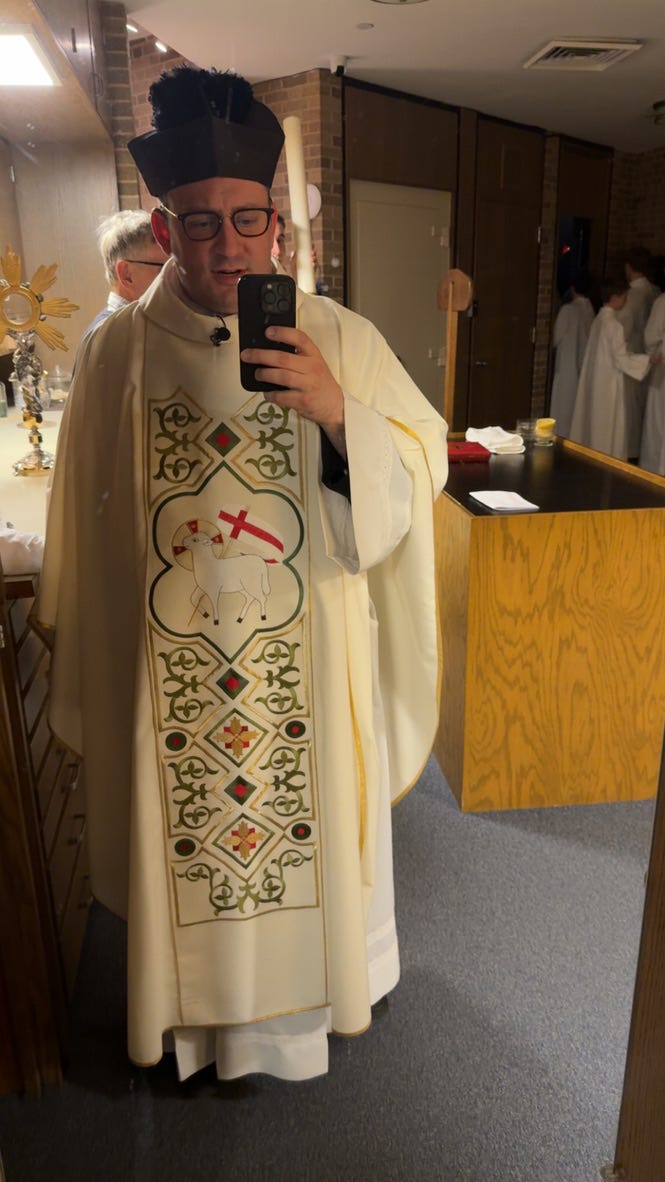

This is my “Jesus year.”
Indeed, last May I turned 33, the age our tradition says is the age of Christ when he died.
To mark the day last May, Fr John and Deacon Sam greeted me by saying, “Crucify him!”
But really, because celibacy adds 70 years, in priest years I am actually 103.
And as I settle into my venerable old age, there are fewer and fewer hills I am willing to die on. One hill that I will die on until the bitter end is the following: The West Wing starring Martin Sheen, which aired on NBC from 1999-2006, is the greatest television show ever made.
Full stop.
Near the end of the first season, it’s revealed that Leo McGarry, the president’s loyal chief of staff, had been in recovery for a substance addiction. He is raked through the coals by the press, but stands by his character and affirms the progress he’d made in his life. Many episodes later, when Josh Lyman, an advisor to the president, goes through his own PR crisis, Leo McGarry sits him down and tells him this story:
A man was walking down the street when he suddenly falls through an open manhole. He sees a priest walking by and yells, “Father, can you help me out?” And the priest scribbles out a prayer and throws it down. He sees a doctor walking by and yells, “Hey Doc, can you help me out?” And the doctor writes out a prescription and throws it down. Suddenly the man sees a friend walking by and yells, “Hey pal, can you help me out?” To his shock and horror, the friend jumps into the hole. “What’d ya do that for? Now we’re both down here!” “Yeah,” his friend replies, “but I’ve been down here before, and I know the way out.”
—
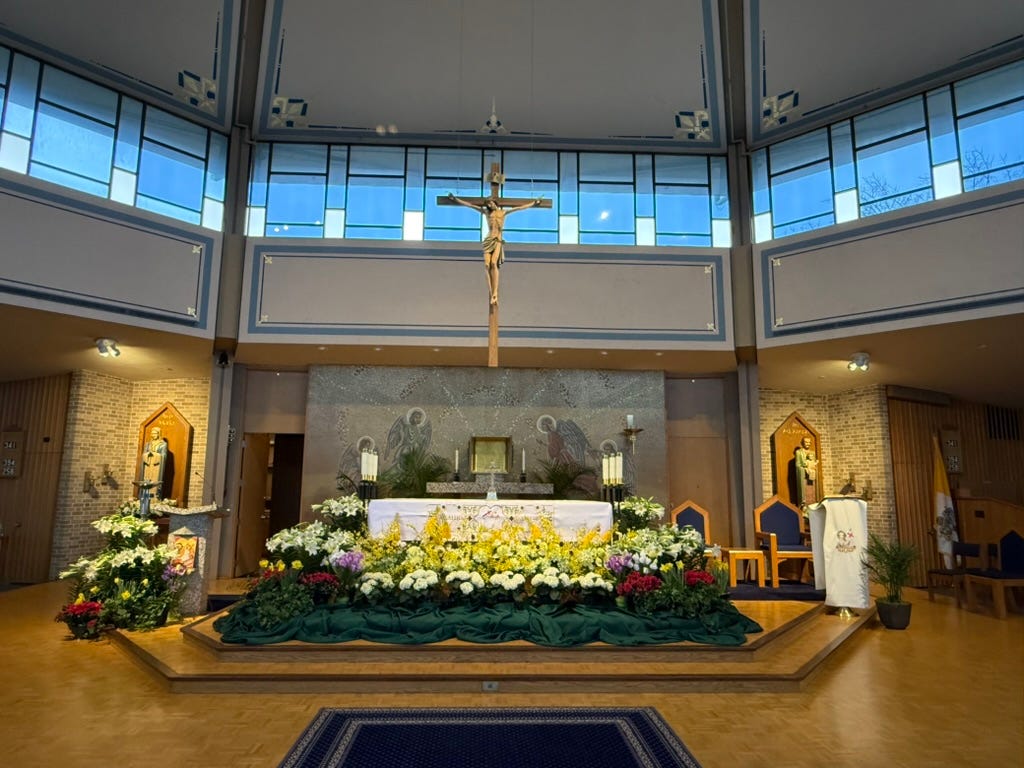
As we come to the conclusion of this Sacred Paschal Triduum, these three days of walking with Jesus as he moves from dinner with his friends in the Upper Room to the Garden and to prison, to Calvary and the Cross to the silence of the tomb, and now as we - with all the celebration and splendor the Church can muster - mark the night on which “he rose victorious from the underworld”, we recall the basic shape of this divine drama in which we are invited to participate.
One day, long ago, by his own volition and in total freedom, God sent his spirit to hover over the formless waters of chaos and darkness; into that chaos he spoke his Eternal Word, and brought light, order, life, and peace. At the top of that creation he ordained that two should be made in his image and in his likeness, and live with him in harmony in his garden. To know goodness, one must be capable of evil, and into that garden lurked a serpent, the most cunning, deceptive creature ever made. His words were smoother than oil, but his tongue was an unsheathed sword, and in his wickedness that creature lied to Eve and likewise to Adam, and convinced them that disobedience was a way to fullness of life. Instead, just as God had warned them, disobedience was the pathway to shame, violence, and death.
God did not abandon humanity, but sent them forth from the garden to toil and live; to be fruitful and multiply. Through the ages “God spoke in partial and various ways to our ancestors through the prophets,” making covenants with his people, leading them from slavery, feeding them with manna and honey from a rock; yet in every age, in each generation, they preferred the lure of disobedience to the promise of life in abundance.
In every age, in each generation, the Father of all creation stayed faithful to his promise, and through his prophets foretold a savior, one mightier than any who had been sent before. He taught the chosen people to look for signs of this savior, so that they would recognize him when he came.
“The true light, which enlightens everyone, was coming into the world…The world came to be through him, but the world did not know him. He came to what was his own, but his own people did not accept him.
“But to those who did accept him he gave power to become children of God.” The Word, present at the beginning, the Word spoken by the Father over the formless void, the Word spoken by the Father into the darkness and chaos, and the Word who spoke into being all of creation, “the Word became flesh and made his dwelling among us, and we saw his glory, the glory as of the Father’s only Son, full of grace and truth…From his fullness we have all received grace in place of grace.”
This Word of God was named Jesus, which means “salvation of God”. From the very beginning he remained obedient to his mission: to live our life and experience it in all things but without sin; to die our death in payment of the wages of sin, and to rise from the dead as the first fruits of the resurrection of all creation.
“This is the night, when Christ broke the prison bars of death…
Our birth would have been no gain, had we not been redeemed.
O wonder of his humble care for us! O love, O charity beyond all telling,
to ransom a slave, he gave away his son.
O truly necessary sin of Adam, destroyed completely by the death of Christ.”
In the Gospel tonight, we encounter Mary Magdalene, the one who was chosen by the Lord to be the “apostle to the Apostles”, the first to witness and then proclaim the resurrection. They go to the tomb “very early in the morning.” As the women approached, the earth shook as an angel of the Lord descended from heaven and rolled back the stone for them.
The resurrection of Jesus is the definitive turning point of all of human history. The one thing that every person and every culture had been trying to avoid, delay, mitigate, or at least explain - death! - has just been conquered, and the new age had come. The re-creation of the whole cosmos has begun, the recalibration of all creation under the banner of life and grace is underway; the old order has passed away and the new self, living by a new order, in a new age has come.
What are the first words spoken in this new age?
“Do not be afraid.” “Peace be with you.”
The message of the angel to Mary Magdalene at the tomb early that first morning is likewise the message to each of us, and must be the content of all of our preaching, teaching, and service: “Do not be afraid. I know that you are seeking Jesus the crucified. He is not here, for he has been raised, just as he said….He is going before you to Galilee; there you will see him.”
Galilee? We can’t see him any closer than that? From the Church of the Holy Sepulcher in Jerusalem to the gate of Capernaum is 162 kilometers, exactly 100 miles, and according to Google Maps is a 37 hour walk.
Did it have to be Galilee? Yes, it had to be Galilee. Why?
If you want to be reborn, if you want the life of the new age, then you have to go back to the beginning. You cannot be only half reborn, one foot in the new age and one foot in the old; this part for Jesus and this part for me; if you want the hundredfold, then you must go all in.
For the disciples, back to the beginning meant back to the shoreline of Galilee. Back to the place where he first met them, first called them, first spoke their names, first called them up out of the boat onto the water, first taught them, first rebuked them, first saved them from winds and seas, and first called them himself that they might come and follow him.
We’ve quoted Dorothy Day on this topic so many times, and when we think about our lives, our world, our hearts…these words hardly need repeating: we have made things here below much harder than God intended them.
And we can think to ourselves that if we could only show the world what Jesus could do, that this place would be bursting at the seams. We’d need more than three churches in Elmhurst; if people knew what grace could do, it would be impossible to ignore.
But it isn’t “somebody else” that the Lord is calling back to the beginning, back to the basics; it’s you, and it’s me.
Jack, Mihael, Natan, Stefan, Kayla, Michael, Russ, and Scott: as you are received into and embrace the fullness of faith tonight, you are witnesses to us of the power of going to the beginning. In these months of preparation, you have learned that the words spoken by the angel at the tomb that resurrection morning are true: indeed the Lord has gone before you, has met you at the beginning, and has walked with you and led you here; not just here to Visitation’s Easter Vigil, but here to this precise moment in the long journey of your lives, here to a definitive and beautiful new beginning.
So this is the promise and joy of Easter:
that as we look around at whichever manhole in the street we happened to have fallen into, and as all of the usual people, places, and things leave us feeling unseen, unheard, or out of luck,
We look around and see this friend, this great and powerful and cosmic friend
who made himself small for my sake and yours,
this Jesus, this risen Jesus, with gaping holes still present in his hands and feet,
Who has gone down into this mess ahead of us, to meet us, to tell us:
“Peace be with you, do not be afraid. I’ve been down here before,
and I know the way out.”