



When I was in the seminary, I had the opportunity to spend a semester studying in Rome during college. Whenever I could, I traveled on weekends and during short breaks. One of the great gifts of living in Europe is that an entirely different country can be only a train ride away, and so whenever the chance presented itself, I tried to explore as much as I could.
There was one place in particular that I had always wanted to visit ever since I began studying French in high school: the tiny country of Luxembourg.
Luxembourg is sometimes jokingly described as the Rhode Island of Europe. It is a small country nestled between France and Germany, but it has an extraordinarily rich culture and a deep Catholic history. What fascinated me most about the place was the linguistic complexity of everyday life. One evening I met a twelve-year-old boy in a restaurant who was taking language lessons from the owner. This child already spoke four languages fluently: English, French, German, and Luxembourgeois, a language that sounds like an unusual fusion of French and German. Listening to them converse back and forth left my brain thoroughly confused.
While I was there, I attended Mass at the cathedral—Notre Dame, as so many European cathedrals are called. The liturgy was celebrated in French, and I remember being delighted that I could follow at least a portion of the homily. The priest began with a simple question:
Qui est Jésus?
Who is Jesus?
That was the one line I understood perfectly. Everything that followed quickly dissolved into sounds that my limited French could not keep up with. But that single question has remained with me ever since. More than a decade later, it still echoes in my mind, because I realized that I had never really asked it with such simplicity and seriousness.
Who is Jesus?
The Gospel of the Transfiguration invites us to ask precisely that question.
The scene described in Matthew 17 comes immediately after an important exchange between Jesus and His disciples in the previous chapter. Jesus asks them, “Who do people say that the Son of Man is?” They offer several possibilities. Some say He is Elijah. Others think He is one of the prophets returned. Perhaps a great teacher sent by God.
Then Jesus presses them further: “But who do you say that I am?”
Peter answers with the confession that lies at the heart of Christian faith: “You are the Christ, the Son of the living God.” Jesus blesses him for this insight and entrusts him with a profound mission, giving him the keys of the Kingdom and establishing him as the rock upon which the Church will be built.
Yet almost immediately afterward, the conversation turns in a direction the disciples do not expect. Jesus begins to speak about His coming suffering. He tells them that He must go to Jerusalem, where He will be handed over, tortured, and killed, and that on the third day He will rise.
Peter cannot accept this. He protests strongly, insisting that such a thing must never happen.
Jesus responds with a startling rebuke: “Get behind me, Satan. You are thinking not as God does, but as human beings do.”
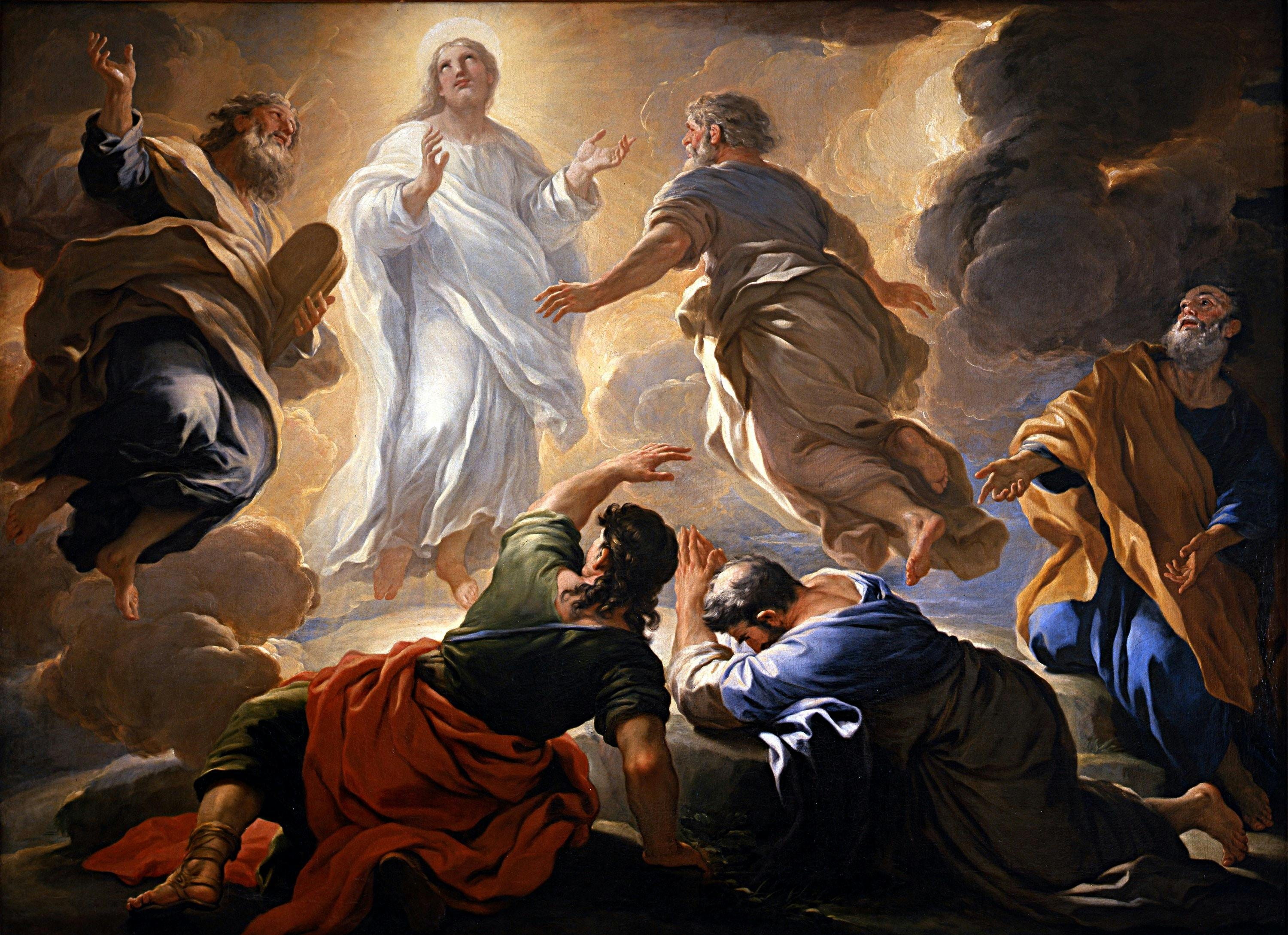
It is immediately after this moment that Jesus leads Peter, James, and John up a mountain, where the mystery of the Transfiguration unfolds before them. His face shines like the sun. His garments become dazzling white. Moses and Elijah appear, speaking with Him. A cloud overshadows them, and from the cloud comes a voice: “This is my beloved Son, with whom I am well pleased. Listen to Him.”
At first glance, we might wonder why such a dramatic revelation was necessary. Had the disciples not already seen enough to know who Jesus was?
But we must remember that Peter, James, and John did not possess the advantage that we do. They had not yet experienced centuries of theological reflection on the mystery of Christ. They did not have creeds or councils to clarify what it means to say that Jesus is both true God and true man. They had only their lived experience of walking beside a man who was gradually revealing Himself to them.
In many ways, we find ourselves in a similar situation today. Even after two thousand years of Christian history, there remains a surprising amount of confusion about who Jesus actually is. For many people, faith has been reduced to the memorization of theological statements that remain disconnected from a living relationship. We know many things about Jesus, about the Church, about the tradition—but we do not always know Him personally.
This creates a peculiar kind of spiritual crisis. We believe, but we believe without fully believing.
Our culture today often expresses a certain skepticism toward spiritual claims. Many people do not wish to abandon the moral values associated with Christianity—compassion, forgiveness, human dignity—but they are less comfortable with the person of Christ Himself. The reason is simple enough: Christ calls us to conversion. He asks for a transformation of our lives, our relationships, our priorities. That is demanding, and so it is tempting to separate the teachings of Jesus from Jesus Himself.
When this happens, Christ is reduced to a pair of distortions. On the one hand, He becomes a harmless spiritual teacher whose primary message is simply that we should be kind to one another. On the other hand, He becomes a distant judge who seems to know little about us except our sins. Neither image bears much resemblance to the Jesus revealed in the Gospel.
The Transfiguration offers a corrective to these distortions. On the mountain, the disciples see the humanity of Jesus—this same humanity that eats with them, walks with them, and shares in the ordinary rhythms of life—suddenly filled with divine glory. The light they behold is not merely a spectacle meant to impress them. It is a glimpse of the destiny that awaits those who belong to Him.
Christ reveals not only who He is, but who we are meant to become.
From that mountain, Jesus will continue the journey that leads to the cross. He will suffer and die, and on the third day He will rise again. The Resurrection becomes the turning point of all human history. The one reality that every civilization has feared—death itself—is finally defeated. Death is no longer the ultimate end of human existence, but the passage into the fullness of life that God has prepared.
The Resurrection also means that Christ is not confined to the past. The tomb that was meant to contain Him could not hold Him. The risen Lord is alive and active. He seeks us out—not to condemn us, but to heal us.
This is why Lent is described as a season of freedom. Yet Christian freedom is often misunderstood. As children, many of us imagined freedom as the absence of authority. We compared our supposed independence with that of our friends, boasting about how late we could stay out or what rules we could ignore.
But freedom in the Christian sense is something far deeper. It is the ability to live truthfully within reality. It means facing our lives honestly—our strengths and weaknesses, our relationships, our wounds, and our hopes—and allowing Christ to transform them.
St. Irenaeus captured this beautifully when he wrote that “the glory of God is the human person fully alive.” Christianity is not merely a system of moral regulation. It is the process by which our humanity is gradually transformed by divine life.
The tradition of the Church often describes three mountains that frame the life of Christ. First there is the Mount of Beatitudes, where Jesus teaches His vision of the Kingdom and the life to which His followers are called. Eventually we will walk with Him to the mountain of Calvary, where He will give His life for the salvation of the world.
But between those two stands a third mountain: Mount Tabor, the mountain of the Transfiguration. It is here that the disciples are allowed to glimpse His glory before they witness His suffering. The vision strengthens them for what lies ahead.
And it strengthens us as well.
Because once we begin to understand who Jesus truly is, fear begins to lose its hold on us. We can bring to Him the burdens we carry—the sins we are afraid to confess, the wounds we struggle to forgive, the parts of our past that still trouble us. Christ does not seek us out in order to shame us. He seeks us in order to restore us.
If you are unsure where to begin, begin simply. When you receive the Eucharist, speak to Him honestly. Do not worry about using perfect words. Tell Him what you notice about your life. Tell Him when you are tired, confused, or uncertain. A conversation is the beginning of a relationship.
Gradually, small steps toward freedom begin to follow. A difficult apology may be offered. A long-held grudge may be released. A long-avoided confession may finally be made. These steps are not peripheral to the Christian life; they lie at its very heart.
Your life is not meant merely to be endured. It is meant to be lived in abundance.
C. S. Lewis once observed that if a person discovers he is traveling in the wrong direction, progress may require turning around and retracing his steps until he reaches the crossroads again. That may feel like moving backward for a time, but in reality it is the only way forward.
And so we return to that simple question that has echoed in my mind since that Mass in Luxembourg many years ago:
Qui est Jésus?
Who is Jesus?
He is the risen one, the transfigured one, the living Son in whom the Father is well pleased.
And the voice from the cloud still speaks to us today: Listen to Him.


