



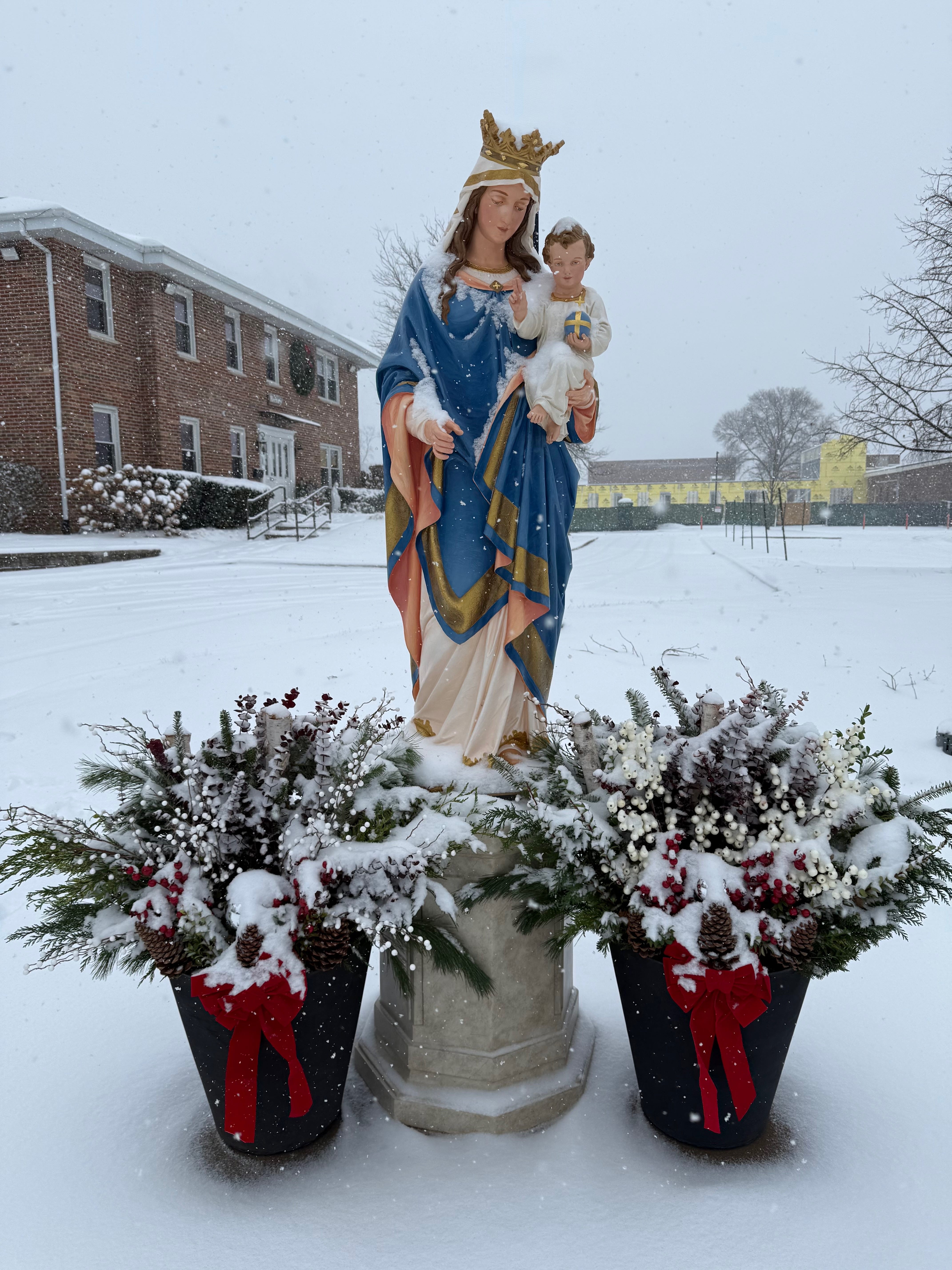
Once again, happy New Year. I hope you all had a peaceful evening and a gentle start to the day—whether that meant being in bed by ten or, like Deacon Sam and me, staying out a little later at what I can only describe as a priest party (a trademark phrase, by the way). However you welcomed the new year, I hope these days tucked between Christmas and ordinary life have been restful and grace-filled.
Today the Church celebrates the Solemnity of Mary, the Mother of God. The ancient title for this feast is Theotokos, a Greek word that means God-bearer: the one who bore God for us.
Interestingly, this feast came about almost backward. From the very beginning, Christians loved and honored Mary—not because of abstract theology, but because of relationship. At the foot of the Cross, Jesus looks at John and says, “Behold your mother.” Then he looks at Mary and says, “Woman, behold your son.” In that moment, something new is created: a familial bond between Mary and the Church.
From the earliest days, Christians experienced Mary as a motherly presence. She was there with the disciples after the Resurrection, present in the Upper Room at Pentecost, praying as the Holy Spirit descended. Some of the very earliest Christian artwork includes her image. Mary was never absent from the life of the Church.
But questions eventually arose—as they always do.
Christians knew Jesus was God. But what exactly did that mean? Was he fully divine? Partly divine? Merely inspired? Adopted by God? Wearing humanity like a costume?
At the Council of Nicaea, famously attended by Saint Nicholas, the Church rejected the claim of Arius that “there was a time when Jesus was not.” Jesus, the Church insisted, is eternal—true God from true God.
Still, confusion lingered. A century later, at the Council of Ephesus, the Church definitively proclaimed that Jesus Christ is fully God and fully human, possessing two distinct natures united in one person.
And that declaration changed everything.
Because if Jesus is truly God—and Mary is truly his mother—then Mary is rightly called Mother of God.
This is not poetic exaggeration. It is simple logic. If she is not merely the mother of a holy man, but the mother of God himself, then her role in the life of the Church deepens in astonishing ways. It opens the door to her intercessory role, to Marian devotion, and to our experience of being spiritually accompanied by her.
The Church has always understood the words spoken at the Cross as spoken also to us. We can say to Mary, “Behold my mother,” and trust that she looks upon us and says, “Behold my children.”
Recently, the Vatican reflected on the many titles given to Mary across the centuries. Some are more theologically precise than others—but what stood out most was the Church’s consistent return to one title above all others: Mother.
Mother of God.
Mother of the faithful.
Mother of Christians.
Mother of clergy.
Mother of mothers.
Mother of fathers.
Mother of all.
Mary relates to us not as a distant queen, nor a severe judge, nor an absent figure—but as the mother the world needs: one who intercedes, who mediates, who says, “Come to me. Let me lead you to my Son.”
That maternal voice echoes throughout Marian apparitions. At Our Lady of Guadalupe, she says to Juan Diego, “Am I not here, I who am your mother? Why are you afraid?” At Lourdes, she insists on building a place of prayer—not for herself, but so that people might come to her Son.
Mary always leads us to Jesus. Always.
So here’s the question I’ve been sitting with: What would this new year look like if we lived more confidently under the intercession of the Mother of God?
Not because we worship her. Not because we think she’s divine—she isn’t. She’s not “diet God.” She is one of us. A woman who said yes. A woman who was faithful. A woman who became the Mother of God.
Maybe this year looks like a more faithful daily Rosary—something many of us intend but don’t always manage. Maybe it means setting up a small Marian shrine in your home. A simple image. A short prayer. A quiet reminder.
Would someone walking into your house know you’re Catholic? Would they know your home lives under the mantle of Our Lady?
Maybe it’s changing your phone background. Or blessing a statue in your yard. Small, quiet acts that reshape the space around you.
Because the deepest things are often the quietest things. And it is those steady, faithful, Marian choices that slowly—but truly—change the world.
As we begin this year, I invite you to name one intention. One person. One hope. One burden. Something you want to carry forward—or something you’d rather leave behind.
Hold it gently. And offer it to the Lord through Our Lady.
Holy Mary, Mother of God, pray for us.


