



Before I came to Visitation, part of my assignment was teaching high school moral theology. I did it for three years, and I loved it. But there’s a particular look in a high schooler’s eye when they discover that Father has Snapchat… or PlayStation Online… or Instagram. It’s the look that says, We’re going to find you.
So you learn quickly to be creative with your username. Instagram is one thing—you can use that for ministry. But I don’t want to play Red Dead Redemption with you.
That said, I don’t mind telling you this: my Steam name and my PS5 username are both portafidei. Pretty priestly, right? Latin. Very subtle.
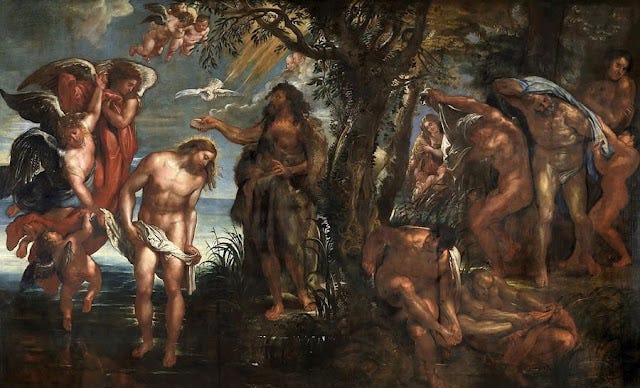
Porta Fidei means “the doorway of faith.” And baptism is what the Church has always called by that name—the door of faith.
In the ancient Church, if you were not baptized, you were not allowed through the doors of the church. You stood in the narthex—a Greek word that literally means “box.” You were “outside the box,” not as a punishment or a rejection, but because baptism unlocks the door, it’s what makes us members of the Body of Christ. Baptism is the doorway into real belief, real spiritual life, grace, the sacraments—into heaven itself.
For most of us, the day of our own baptisms meant absolutely nothing, having been babies and all. And the reason we know that day mattered at all is because the people who brought us to the font taught us that it mattered. We pray that parents and godparents live in such a way that their own baptism clearly means everything—so that the children entrusted to them can someday discover that theirs does too.
But let’s zoom out.
At the very beginning of Scripture, creation itself begins with water. The Spirit of God hovers over the waters, and out of the water comes dry land—creation, life, order. The Spirit hovers, and a new world emerges.
That pattern repeats with Noah. The world is washed clean. And how do they know the flood is over? Noah sends out the dove. First it returns with nothing. Then it returns with an olive branch—dry land exists. Finally, it does not return at all, because it has found a place to live.
Out of the water comes a new creation.
That is baptism.
For many centuries, and still today in many Christian traditions, baptism was full immersion. You go down into the water… and you come up out of it. Death and resurrection.
Interestingly, a major moment in the Roman liturgy when baptism is so explicitly invoked is at a Catholic funeral. Before the casket even enters the church, it is sprinkled with holy water, and the priest says:
“In the waters of baptism, N. died with Christ and rose with Him to new life.”
Before the doors open, before the body enters, the Church reminds us: this person already died once, and already rose.
St. Paul puts it plainly: whoever lives in Christ is a new creation.
You are no longer merely a creature.
You are a son or daughter of God.
Every other religious system in history tends to revolve around appeasing the gods: this for that, sacrifice for profit. If I do this, the crops will grow. If I don’t, disaster will come. Natural catastrophe always leads to the same question: Who made the gods angry?
Christianity enters that world with something utterly baffling.
A God who wants nothing from us except our hearts.
A God who creates freely, gives generously, and says, “All of this is yours.”
A God who says, “A bruised reed I will not break. A smoldering wick I will not quench.”
No catch.
And yet, many of us still live as if God is a cosmic accountant—hiding in the bushes with a clipboard, waiting to audit our lives.
That is not who God is.
God wants communion.
God wants closeness.
God wants to draw all creation back to Himself.
So much so that He sends His Son—not to exploit us, not to manipulate us, but to become our brother, to live our life and die our death, and to walk us home.
So what actually happened at your baptism?
Yes, you were freed from original sin. But that’s only the beginning.
You became a member of the Body of Christ.
You became an heir of the Kingdom of God.
You became a temple of the Holy Spirit, with faith, hope, and charity burning within you like a pilot light that will never go out.
And finally—you became what you already were meant to be:
a beloved son or daughter of the Father.
And because of that:
God is not out to get you, God is not waiting for you to fail, God is not surprised by your sins.
He promises to love you, always and no matter what;
He promises to forgive you, always and no matter what;
He promises that he will never abandon you, never and no matter what;
And he promises that whenever, whyever, wherever, however the time comes: there will be a place prepared for you in his house.
In the grand scheme of things, I haven’t been a priest very long…but after eight years of hearing confessions I can say that the ratio of people who really are sorry and want to improve vs. people who aren’t sorry or sin because they hate God is like 10,000:1.
Most people I meet in the confessional aren’t defiant.
They’re afraid.
They feel stuck.
They think they’ve strayed too far.
But Scripture says something beautiful: “While the prodigal son was still a long way off, his father caught sight of him and ran to him.”
That means the Father was already out there looking, before the son decided to return.
So here are the questions I want to leave you with:
Do you know the date of your baptism?
Because you died and were reborn on that day. Celebrate it like a birthday! Get your baptism candle out of your baby box in Mom’s attic and light it for a few minutes on your anniversary.Do you live in a way that shows baptism matters—especially if you are a parent or godparent?
And finally:
3. Where do you stand in relation to the Porta Fidei—the doorway of faith?
Have you walked through it?
Or are you still standing outside, even if your body is in the pew?
The Lord is inviting you.
He’s gone before you to prepare a place for you, and wants nothing more than to welcome you into it.


